

As the country with the largest land area in Oceania, Australia has been impacted by climate change in recent years. To ensure sustainable development, the country’s sustainability policies focus on environmental conservation as well as green energy development. Furthermore, hydrogen energy has become a significant part of Australia’s sustainability initiatives. Through the development of hydrogen energy, Australia has had a chance to collaborate with many countries across the globe.
Section:|Agencies|Policies & Strategies|AU-Taiwan|International Collaboration|Table|
Agencies
- Department of Climate Change, Energy, the Environment and Water (DCCEEW)
- Department of Industry, Science and Resources (DISR)
- Department of Foreign Affairs and Trade (DFAT)
- Australian Renewable Energy Agency (ARENA)
- Net Zero Economy Agency (NZEA)
- Australia’s Nature Hub
Policies & Strategies
Future Gas Strategy
In May 2024, the Australian government launched the Future Gas Strategy, which has four main objectives: supporting the decarbonization of Australia’s economy, ensuring energy security and affordability, bolstering Australia's reputation as an attractive trade and investment destination, and helping Australia's trade partners achieve net-zero emissions. The policy has repeatedly demonstrated Australia's determination to reach net-zero emissions by 2050, with a particular focus on the market price of natural gas and the adaptation of natural gas use throughout the country. Additionally, the policy has stated that Australia will open up areas offshore for greenhouse gas storage.
Future Made in Australia
In April 2024, the Australian Prime Minister announced the launch of the Future Made in Australia initiative, with a government allocation of AUD$22.7 billion (2024-2025 Budget). The initiative aims to maximize the economic and industrial benefits of achieving net-zero emissions while ensuring Australia's strategic position in the global economic landscape. In addition to expressing the desire to help trade partners reduce emissions, this legislation includes manufacturing industries such as cement, brick, glass, and fertilizer, as well as industries such as food processing and critical mineral refining.
Even though the government has acknowledged a lack of specific targets, Australia aims to utilize this legislation to further strengthen its commitment to emission reduction. In addition, issues such as the manpower required for implementing such legislation and potential economic problems (such as the rigour of investments and loans as well as the possibility of increased inflationary pressure) remain challenges that the government needs to address and resolve. (Prime Minister of Australia, 2024) (ABC News, 2024) (Australian Government Budget,2024)
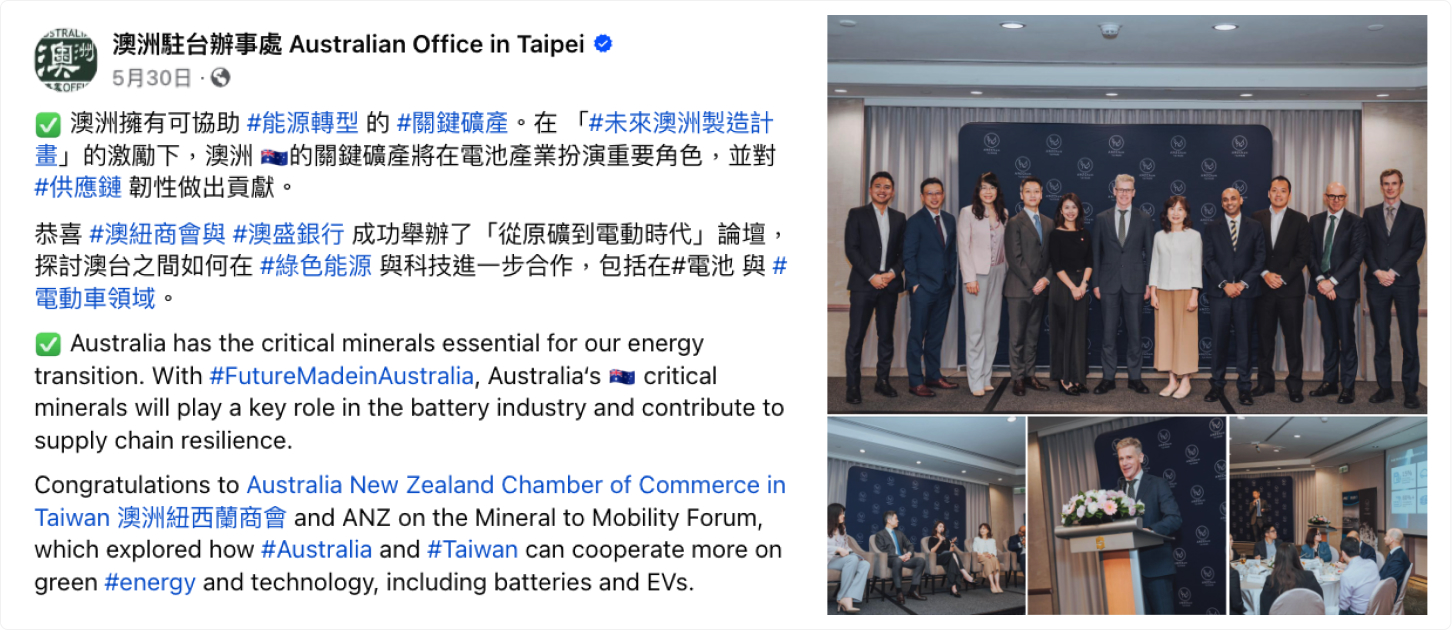
Future Made in Australia (Image Source © Australian Office in Taipei)
This legislation might create more opportunities for cooperation between Taiwan and Australia. Taipei Economic and Cultural Office in Australia Ambassador Douglas Yu-tien Hsu stated that he is optimistic about Taiwan-Australia cooperation in hydrogen energy. Currently, implementing hydrogen energy is challenging in terms of competitiveness, commercialization, and transportation. Despite this, these challenges have presented opportunities for Taiwan to leverage its scientific research capabilities. For instance, Taiwanese businesses can benefit from helping Australian hydrogen energy companies resolve technical issues such as wastewater treatment. Furthermore, Taiwan and Australia laid a solid foundation for R&D collaboration in hydrogen energy by signing the Taiwan-Australia Scientific and Technological Cooperation Arrangement (STA) in May 2024. (CNA, 2024)
National Energy Performance Strategy
In April 2024, Australia’s Department of Climate Change, Energy, the Environment and Water (DCCEEW) launched the National Energy Performance Strategy, which stated that by 2026, the Australian government will invest AUD$15.2 million in energy demand management and the efficient utilization of various types of energy. Through this initiative, the Australian government aims to achieve energy transition, reduce energy costs, and enhance energy reliability and security. In addition, the government also hopes this strategy will create a healthier country by encouraging dialogue on energy-related issues between federal agencies, local governments, and private citizens while increasing employment and ensuring equitable energy throughout society.
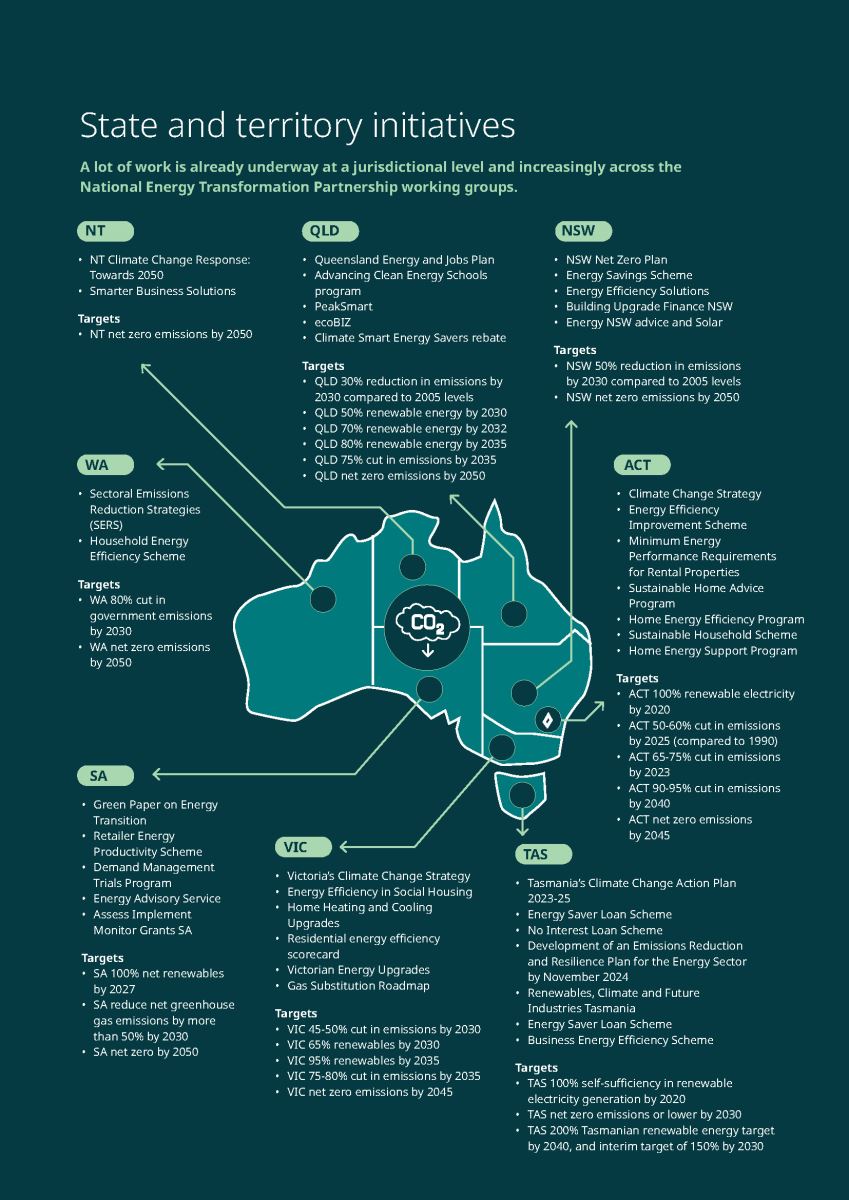
Energy-related Projects Launched By Australian States and Territory Executive Governments
(Image Source: © DCCEEW)
Solar Sunshot
In March 2024, the Australian government announced the drafting of the Solar Sunshot Program, which will allocate AUD$1 billion in subsidies to develop the manufacturing capacity of solar photovoltaic supply chains. The foundation of this program dates back to the July 2023 establishment of the Net Zero Economy Agency, which promotes economic and industrial transformation towards net zero while fostering Australian investment and manufacturing. Solar energy, hydrogen energy, and critical minerals are the three main focus areas for future development.
This project is a collaboration between the Australian Renewable Energy Agency (ARENA) and the private sector. The Australian government will also help with the project’s design and implementation. In addition to deploying and innovating advanced technologies, ARENA will focus on the supply chain of related components such as silicon ingots, wafers, solar cells, and module assembly. One in three households have solar panels in Australia, making it the leading country in usage rate anywhere in the world. Despite this, only 1% of Australia’s solar panels are domestically manufactured. (TECO in Australia, 2024)
Hydrogen Headstart
In May 2023, the Australian government announced an allocation of AUD$2 billion from the federal budget to fund the Hydrogen Headstart Program and other large-scale hydrogen production projects. These initiatives aim to accelerate the development of Australia's hydrogen and clean energy industries, help Australia connect to the global hydrogen supply chain, and promote employment opportunities and investment potential. The program was jointly designed and developed by ARENA and DCCEEW. It will use a competitive process to select large-scale domestic projects in Australia that focus on leveraging renewable hydrogen production and products derived from this process.
National Climate Resilience and Adaptation Strategy 2021-2025
In October 2021, DCCEEW released the National Climate Resilience and Adaptation Strategy 2021-2025, which aims to help Australia predict, manage, and adapt to climate change. In addition, this strategy aligns with the UN Paris Agreement and covers areas including the environment and infrastructure as well as social and economic issues. The strategy contains three objectives: promoting investment and action through collaboration, improving climate information and services, and assessing effectiveness by making adjustments as needed.
The strategy also states that Australia faces not only environmental hazards due to climate change but also economic costs that accompany these changes. For example, each farm has lost nearly AUD$30,000 because Australia's agricultural output has decreased by 23% over the past 20 years. The strategy also points out that sustainability issues impact industries across the board, not just a single sector. Therefore, the Australian government has stated that cross-industry solutions and collaboration are necessary to effectively address the impacts of climate change.
Australia’s Strategy for Nature 2019-2030
In January 2019, Australia’s Nature Hub launched Australia's Strategy for Nature 2019-2030, a framework for federal and local governments to manage Australia’s environment. The Australian government has also adjusted and revised its strategy based on the UN’s Kunming-Montreal Global Biodiversity Framework. In regards to the development of this strategy, Australia’s Minister for the Environment and Water stated that there are seven critical targets for Australia's environment:
- Conserving 30% of Australia's land.
- Protecting 30% of Australia's marine environment.
- Committing to a zero-extinction policy.
- Restoring degraded land, inland water sources, and marine and coastal ecosystems.
- Addressing the impact of invasive species.
- Establishing a circular economy and reducing the ecological impact of plastics.
- Minimizing the impact of climate change on the environment.
In addition, these seven targets will be achieved through these three key elements:
- Ensuring that environmental data and information are widely accessible and support planning.
- Including the environment within government and corporate decision-making in terms of financing, policy reform, regulation, and planning.
- Ensuring equal representation in decision-making related to the environment, particularly regarding the equal rights of indigenous people.
Queensland’s Zero Emission Vehicle Strategy 2022-2032
In March 2022, the Queensland government announced Queensland’s Zero Emission Vehicle Strategy 2022-2032 to support Australia's commitment to achieving net zero carbon emissions by 2025. Queensland’s implementation plan and targets for Zero Emission Vehicles (ZEVs) have been serving as a model for ZEV policies in government agencies throughout the country. Queensland aims to be a leader in this field by providing clear guidelines that reduce transportation emissions while resolving issues during the widespread transition to ZEVs. This includes: improving vehicle emission standards, aligning with international carbon standards, enhancing national fuel quality standards, stimulating markets and attracting international vehicle manufacturers, adopting emission control technologies, implementing policies that incentivize the adoption of ZEVs, ensuring adequate ZEV charging infrastructure through the National Construction Code, and promoting policies for the procurement and production of renewable energy.
Various strategies the Queensland government has launched related to the environment and energy: The Future Fuels and Vehicles Strategy, Queensland Transport Strategy, Queensland Climate Action Plan, and Queensland Hydrogen Industry Strategy. In terms of transportation, the Queensland government prioritizes encouraging cleaner and more environmentally friendly modes of transport, developing ZEV manufacturing and supply chain capabilities, creating and supporting infrastructure for ZEVs, and promoting renewable energy and charging solutions. Over the next decade, it’s projected that people and businesses throughout Queensland will be able to use and benefit from ZEVs.
Collaboration: Taiwan and Australia
National Science and Technology Council (NSTC)
In 2023, former NSTC Minister Tsung-tsong Wu met with officials from Australia’s Department of Industry, Science and Resources. During his visit, Minister Wu proposed the Taiwan-Australia Scientific and Technological Cooperation Arrangement (STA). In May 2024 after six months of discussion and planning, Taipei Economic and Cultural Office in Australia Ambassador Douglas Yu-tien Hsu and Australian Representative in Taiwan Robert Fergusson signed the agreement in Canberra. Ambassador Hsu stated that this agreement upgraded Taiwan and Australia’s 2012 bilateral cooperation memorandum of understanding to a formal science and technology cooperation agreement, which reflects the mutual importance placed on each other's research capabilities. This framework will expand and strengthen scientific research partnerships between Taiwan and Australia. In addition, the bilateral research results of such cooperation are expected to have a significant impact on the international community. Taiwan and Australia plan to focus cooperation in four key areas: ICT manufacturing, semiconductor technology and supply chain resilience, biotechnology, and net zero transformation. These efforts aim to lay a solid foundation for further technological cooperation between Taiwan and Australia in the future. (NSTC, 2024) (TECO in Australia, 2024) (Taiwan Today,2024)
Green Harvest
Recently, Ambassador Douglas Yu-tien Hsu and Queensland Deputy Premier Cameron Dick witnessed the signing of an exclusive cooperation agreement between Green Harvest of Taiwan and Hydrogen Utility (H2U) of Australia. The project is set to leverage Australia's inexpensive green electricity and land to create competitively priced green hydrogen, which will then be converted into green ammonia and shipped to Taiwan. H2U’s project is one of the few mature and large-scale green hydrogen projects in Australia. By 2028, the first phase is expected to commence production. During this period, the anticipated annual green hydrogen output is 1 million tons. By 2032, the annual production of green hydrogen is projected to reach 4 million tons. Participants in the H2U project include major international energy and transport companies that are investing in hydrogen development such as Mitsubishi Heavy Industries of Japan, East-West Power of South Korea, Royal Vopak of Australia, and Oricon Corporation of Japan. These partners will help Green Harvest plan the design, outsourcing, and maintenance of infrastructure for the transportation, storage, and power generation of hydrogen energy. Green Harvest will further integrate Taiwan's expertise in semiconductor water treatment technologies and encourage Taiwanese companies to apply these technologies in electrolytic hydrogen production. Additionally, Green Harvest will offer power management services for green hydrogen production by providing technology for renewable energy forecasting and scheduling. (Economic Daily News, 2024) (ANUE, 2024)
International Collaboration
Singapore
In April 2024, Australia and Singapore, both key transshipment hubs, announced a US$20 million cooperation project, the Australia-Singapore Initiative on Low Emissions Technologies (ASLET), which aims to reduce carbon emissions in the maritime industry. This initiative will reduce carbon emissions on the shipping route between Australia and Singapore while providing further support for the Green and Digital Shipping Corridor (GDSC), which the two countries agreed upon in March 2024. The signing of ASLET will unlock new fuel solutions, accelerate the large-scale deployment and adoption of technologies that emit zero or near-zero greenhouse gases (GHGs), and explore cooperation opportunities between Australia and Singapore in green shipping and port infrastructure initiatives. (CSIRO, 2024)
In October 2020, Australia and Singapore signed the Australia-Singapore Memorandum of Understanding for Cooperation on Low-emissions Solutions, which allowed the two countries to share their cooperation experience and collaborate on developing emission reduction technologies. The areas of focus include long-term emission reduction projects, hydrogen-based supply chains, carbon capture utilization and storage, renewable energy trade as well as emissions monitoring and reduction strategies. The cooperation also emphasizes the role of technology in achieving emission reduction outcomes. (DCCEEW, 2020) (MTI, 2020) (SIEW, 2020)
New Zealand
In June 2023, Australia's Climate Change and Energy Minister Chris Bowen and Treasurer Jim Chalmers visited New Zealand to attend the inaugural Australia-New Zealand 2+2 Climate and Finance Dialogue. Subsequently, the governments of Australia and New Zealand signed a joint statement expressing their commitment to exploring joint economic opportunities that help achieve net-zero goals. The two countries agreed to hold the 2+2 Climate and Finance Dialogue annually, establish a net-zero government working group, promote the import of electric and zero-emission vehicles into both countries and strive to achieve net-zero emissions. In addition, both parties will set common regulatory frameworks and indicators while supporting the development of a global guarantee of origin program. (DCCEEW, 2023) (DCCEEW, 2023) (Beehive, 2023)
India
In June 2022, during The 4th India-Australia Energy Dialogue, Australia and India signed The Letter of Intent between India and Australia on New and Renewable Energy Technology. This made India the sixth country to establish a low-emission technology partnership with Australia, following Germany, Singapore, Japan, South Korea, and the UK. Before signing this letter of intent, Australia and India had already committed to working together to reduce the costs of ultra-low-cost solar energy and clean hydrogen. The signing of this cooperation letter of intent is part of Australia's commitment to allocate over AUD$ 500 million to create jobs and support new types of international partnerships. (DCCEEW, 2022) (DCCEEW, 2022) (MNRE, 2022)
International Organizations
Association of Southeast Asian Nations (ASEAN)
In March 2024, Australia held the 2024 ASEAN-Australia Special Summit in Melbourne to commemorate the 50th anniversary of Australia becoming ASEAN's first dialogue partner. Australian Prime Minister Anthony Albanese announced an AUD$2 billion investment fund to support ASEAN partners in their green energy transition. In addition, Australia took this opportunity to adopt the ASEAN-Australia Leaders’ Vision Statement and The Melbourne Declaration. In these two documents, Australia expressed its intention to work with the ASEAN region to promote sustainable development. Australia emphasized that sharing inclusive and equitable solutions across the region is key to addressing global challenges such as climate change and biodiversity loss. Furthermore, Australia committed to accelerating its efforts to phase out fossil fuels while speeding up regional energy transition to create long-term regional security. (TECO in Australia, 2024) (CNA, 2024) (Prime Minister of Australia, 2024) (Australia PMC, 2024)
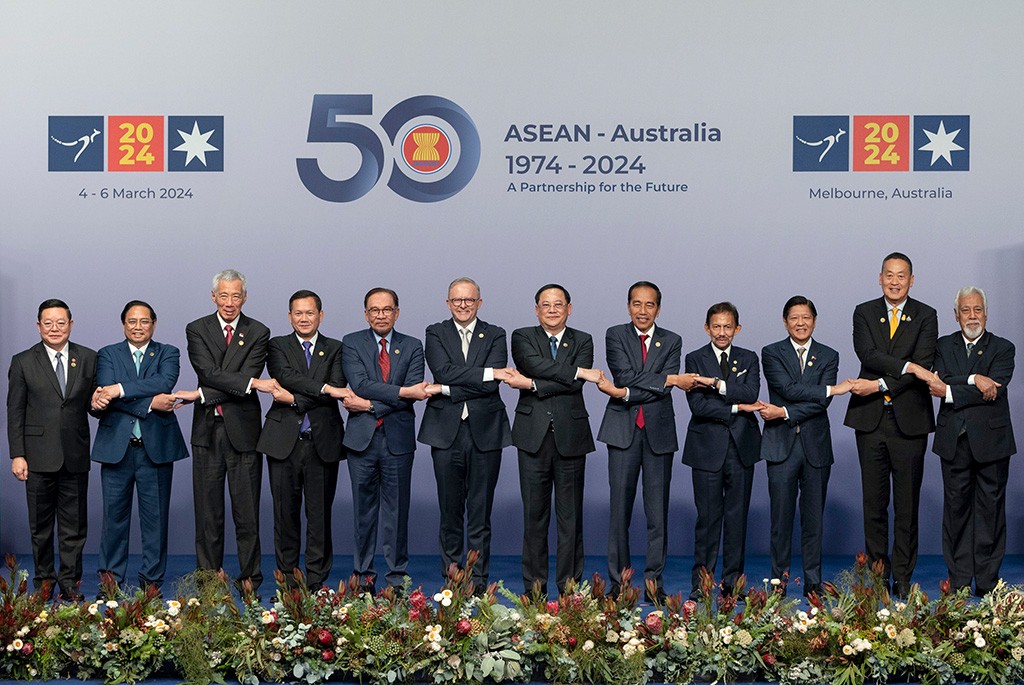
2024 ASEAN-Australia Summit Photo (Photo Source © Australian Government)
Australia's Policy on Energy & Sustainability
| Agency | Policy, Strategy, Project & Initiative |
|---|---|
| Department of Industry Science and Resources (DISR) | |
| Department of Climate Change, Energy, the Environment and Water (DCCEEW) | Long-Term Emissions Reduction Plan
National Energy Performance Strategy National Climate Resilience and Adaptation Strategy 2021-2025 |
| Department of Foreign Affairs and Trade (DFAT) |
Report on the Implementation of the Sustainable Development Goals |
| Queensland Government (QLD Government) |
Queensland’s Zero Emission Vehicle Strategy 2022-2032 Queensland Zero Net Emissions for Transport Roadmap |
| The Treasury, Australian Government | |
|
Australian Renewable Energy Agency (ARENA) Net Zero Economy Authority |
|
| Commonwealth Scientific and Industrial Research Organisation (CSIRO) |
Australia-Singapore Initiative on Low Emissions Technologies |
| Australia’s Nature Hub | |
|
Department of Foreign Affairs and Trade (DFAT) Department of Industry Science and Resources (DISR) Taiwan - National Science and Technology Council (NSTC) |
|
|
Department of Climate Change, Energy, the Environment and Water (DCCEEW) Treasurer of Australia, Australian Government Minister of Finance, Australian Government Minister of Climate Change, Australian Government |
Australia-New Zealand 2+2 Climate and Finance Dialogue |
Keywords: #Australia #Energy #Sustainability
Reference / Sources:
Australian Sources
-
DISR (2024.06) Net zero sector plans for industry, resources and the built environment
-
Queensland Government (2024.05) Queensland Climate Action Plan
-
DISR (2024.05) Future Gas Strategy
-
CSIRO (2024.05) Australia-Singapore Initiative on Low-Emissions Technologies for Maritime and Port Operations (ASLET)
-
The Treasury (2024.05) Future Made in Australia
-
The Treasury - Budget Investing in a Future Made in Australia
-
CSIRO (2024.04) Australia and Singapore partner in $20M initiative to reduce maritime emissions
-
DCCEEW (2024.04) Joint Press Statement on EU-Australia energy relations
-
DCCEEW (2024.04) National Energy Performance Strategy
-
Prime Minister of Australia (2024.04) A future made in Australia
-
ARENA (2024.03) Solar Sunshot Program
-
ARENA (2024.03) Solar Sunshot Background
-
DFAT (2024.03) Singapore and Australia Green and Digital Shipping Corridor
-
Prime Minister of Australia (2024.03) Solar Sunshot for our regions
-
PMC (2024.03) 2024 ASEAN-Australia Special Summit
-
PMC (2024.03) ASEAN-Australia Leaders’ Vision Statement
-
PMC (2024.03) The Melbourne Declaration
-
Prime Minister of Australia (2024.03) Press conference - 2024 ASEAN-Australia Special Summit
-
CSIRO (2024.02) New Tool to Help Australia’s Hydrogen Industry Maintain Hystandards
-
ARENA (2023.10) Hydrogen Headstart
-
DCCEEW (2023.06) Australia and New Zealand make statement at inaugural Climate and Finance Dialogue
-
Parliament Australia (2023.06) Inaugural Australia-New Zealand 2+2 Climate and Finance Dialogue joint statemen
-
DCCEEW (2023.06) New Zealand visit to strengthen net zero collaboration
-
DCCEEW (2023) Hydrogen Headstart Program
-
DCCEEW (2022.05) The Future Fuels and Vehicles Strategy
-
Queensland Government (2022.03) Queensland’s Zero Emission Vehicle Strategy 2022-2032
-
DCCEEW (2022.02) Australia enters into sixth bilateral low emissions technology partnership
-
DCCEEW (2022.02) Australia-India to collaborate on new and renewable energy technology
-
DCCEEW (2021.10) Australia’s Long-Term Emissions Reduction Plan
-
DISR (2021.10) Australia’s plan to reach our net zero target by 2050
-
DCCEEW (2021.10) National Climate Resilience and Adaptation Strategy 2021-2025
-
Queensland Government (2021.07) Queensland Transport Strategy
-
DCCEEW (2020.10) Australia and Singapore to work together to accelerate low emissions technologies
-
Queensland Government (2019.04) Queensland Hydrogen Industry Strategy
-
Australia’s Nature Hub (2019.01) Australia’s Strategy for Nature 2019-2030
-
Australian Building Codes Board National Construction Code
Foreign Sources
-
European Commission (2024.04) EU-Australia agree on importance of energy cooperation
-
Beehive, NZ Government (2023.06) INAUGURAL AUSTRALIA–NEW ZEALAND 2+2 CLIMATE AND FINANCE DIALOGUE JOINT STATEMENT [PDF]
-
UN Environmental Programme (2022.12) Kunming-Montreal Global Biodiversity Framework
-
MNRE, Indian Government (2022.02) International Relations: Memorandums of Understanding
-
MTI, Singaporean Government (2020.10) SINGAPORE AND AUSTRALIA CONCLUDE MEMORANDUM OF UNDERSTANDING FOR COOPERATION ON LOW-EMISSIONS SOLUTIONS [PDF]
-
SIEW, Singapore (2020.10) Singapore and Australia Sign MOU on Low-Emissions Solutions
-
United Nations The Paris Agreement
Other Sources
-
ABC News (2024.05) Future Made in Australia: What we know about the government's flagship budget policy
-
Mission Innovation (2023.07) CEM14/MI-8 Event
-
Daniel Wood, Insurance Business (2022.11) Mandatory climate financial disclosures will help insurers, says expert
-
Jason Symons, HWL Ebsworth (2021.11) Climate Change - Tracking Trends in ASX100 Climate-Related Disclosures
-
Leigh Dayton, Science.org (2014.07) Australia scraps carbon tax
Domestic Sources
-
中央社 (2024.06) 澳洲推未來製造駐澳代表:台澳氫能合作具前景
-
國家科學及技術委員會 (2024.05) 科技外交再添新章 臺澳簽署科技合作協議 聚焦四大重點領域合作
-
駐澳洲台北經濟文化辦事處 (2024.05) 科技外交再添新章 臺澳簽署科技合作協議
-
Taiwan Today (2024.05) Taiwan, Australia sign science and technology cooperation pact
-
經濟日報 (2024.05) 睿禾與澳洲簽台灣首張海外綠氫合作開發協議
-
鉅亨網 (2024.05) 睿禾控股進軍澳洲 簽訂台灣首張海外綠氫合作開發協議
-
駐澳大利亞台北經濟文化辦事處經濟組 郭組長妙英 (2024.04) 澳洲總理宣布本年將公布「澳洲未來製造法案」(Future Made in Australia Act),建立主權製造動能事
-
駐澳大利亞台北經濟文化辦事處經濟組 郭組長妙英 (2024.04) 澳洲聯邦與新州同步發布太陽光電產業之相關投資獎勵,盼實現澳洲未來成為再生能源製造及出口大國事
-
駐澳大利亞台北經濟文化辦事處經濟組 郭組長妙英 (2024.03) 澳洲順利舉行東協特別峰會,宣布20億澳元強化與東協在清潔能源及基礎建設之雙向投資事
-
中央社 (2024.03) 澳洲投資411億 支持東南亞綠能與基礎建設
-
科技發展觀測平台 (2021.11) 澳洲未來燃料和車輛策略

