

Vietnam’s hot and humid climate with an abundance of mosquitos poses a significant threat for the health of its people. Coupled with the country’s aging population, having comprehensive and readily available healthcare has become an urgent need for Vietnam. Since 2017, Vietnam has introduced regulations for the digitalization of healthcare. Moreover, since 2019, Vietnam has been actively promoting initiatives such as electronic medical records (EMR) and smart hospitals. Before 2030, Vietnam also aims to have a digital payment system for healthcare expenses while achieving other related goals.
Section:|Overview|Agencies|Policies & Strategies|Implementation|VN-Taiwan|International Collaboration|Table|
Overview
Vietnam is slowly becoming an aging society. Therefore, the government urgently needs to strengthen its medical institutions by filling personnel gaps. However, Vietnam’s healthcare agencies are still in the initial phases of digitalizing the country’s healthcare system. Thus, there is still significant room for improvement in applying electronic medical records (EMR) to areas such as telemedicine, automated solutions, and AI diagnostics.
In 2017, Vietnam specifically mentioned the need for the digitalization of the country’s healthcare system in regulations related to digital affairs. In 2019, Vietnam officially incorporated the process of digitalizing the country’s healthcare system into law while implementing EMRs. In 2021, Vietnam established a nationwide EMR system to facilitate data sharing among various medical institutions. In 2022, the Vietnam branch of Advantech, a leading medical equipment manufacturer, became the first Taiwanese company to partner with a Vietnamese hospital to create a smart hospital. Thus, further growth in this area is expected in the future. Currently, Vietnam is addressing digital healthcare through its latest regulations that were launched in 2024. These regulations have extended the timeline for developing the country’s digital healthcare until 2045.
Agencies
- Ministry of Health (MoH)
- National Health Information Center (NHIC)
Policies & Strategies
Decision 89/QD-TTg-National Strategy for protection, care and improvement of the people’s health through 2030, with a vision toward 2045
In February 2024, the Vietnamese Prime Minister approved “Decision 89/QD-TTg-National Strategy for protection, care and improvement of the people’s health through 2030, with a vision toward 2045”. This strategy aims to ensure that all Vietnamese can live in safe communities and enjoy healthy physical and mental development. Such an initiative hopes to improve the quality of life for Vietnamese while creating the high-calibre workforce required for national development and defence. Specifically, this policy includes strategies for accelerating the implementation of Vietnam’s healthcare projects and initiatives to improve public health (especially for mothers, newborns, and children) while reducing the disability rate among children of ethnic minorities who live in rural, border, and island regions. Vietnam will also increase funding for preventative healthcare networks and health screening capabilities. This will help establish effective real-time disease control through early detection, monitoring, and identification. By 2045, Vietnam aims to achieve its healthcare vision by creating a comprehensive system that meets a diverse array of needs and offers services on par with advanced countries. (VietnamPlus, 2024) (Vietnam Law & Legal Forum Megazine, 2024) (Baochinhphu, 2024) (Law Net, 2024)
Decision 5316/QD-BYT - Approving Medical Digitalization until 2025 with an Orientation to 2030
In 2020, Vietnam's Ministry of Health approved “Decision 5316/QD-BYT - Approving Medical Digitalization until 2025 with an Orientation to 2030.” This initiative set three key goals for Vietnam’s digital healthcare:
- Develop infrastructure, implement EMRs, and gradually establish a national healthcare data center.
- Standardize the promotion of electronic health documents, EMRs, and management software in medical stations at the community, district, and town levels.
- Create an integrated system for the Ministry of Health that is linked to both the streamlined national system and the streamlined ASEAN system.
In general, the plan aims to ensure that by 2025, 100% of the population will have access to basic health management, over 90% of the population will have EMRs, and medical expenses will be fully payable electronically. By 2030, Vietnam hopes to digitalize more than 90% of the Ministry of Health's data while promoting the digitization of all public sector services as much as possible. (Vanbanphapluat, 2020)
Decision 4888/QD-BYT - National Agenda for e-health Adoption
In 2019, Vietnam's Ministry of Health approved “Decision 4888/QD-BYT - National Agenda for e-health Adoption”, which outlined the country's digital healthcare development plan starting from 2019. The initiative highlights the importance of medical applications such as big data, the Internet of Things (IoT), artificial intelligence (AI), blockchain, and 3D printing. In addition, this initiative states three main goals for Vietnam's digital healthcare:
- Contribute to the effective implementation of Vietnam's health plans by establishing and gradually developing a smart healthcare and disease prevention system.
- Promote the application of information technology in medical examination and treatment institutions. Use EMRs to create smart hospitals, enhance healthcare management through IT applications, and deploy digital office systems.
- Develop a public service portal and one-stop government digital information system. Promote third- and fourth-tier online public services while building a smart health administration system.
The initiative also emphasizes that Vietnam should actively participate in international healthcare organizations and attract foreign investment into its smart healthcare market. (thuvienphapluat, 2019) (MoH, 2019)
Circular No. 49, 2017 - Regulating the Management of Telemedicine
At the end of December 2017, the Vietnamese Ministry of Health issued “Circular No. 49, 2017 - Regulating the Management of Telemedicine”, which provided legal guidelines for the implementation of telemedicine practices. The regulation consists of 14 articles, covering the technical and IT requirements for telemedicine, applicable licenses and qualifications, the provision of medical advice, requirements for diagnostic consultations involving imaging and remote surgical consultations, as well as requirements related to remote training. The regulations clearly stipulate that telemedicine practices must be conducted within nationally recognized medical facilities and carried out by licensed medical professionals. For telemedicine measures that require the use of imaging, the transmission speed of these images must occur over a network of 4Mbps or faster, with additional requirements for the storage and compression of images to facilitate medical procedures. (Tilleke & Gibbins, 2018) (LawNet, 2017)
Implementation
Electronic Medical Records (EMR)
In July 2019, Vietnam's Ministry of Health announced the implementation of Electronic Medical Records (EMR). At the time, 24 provinces were included in the rollout’s first round (out of a nationwide total of 58 provinces and five centrally administered cities). Six of these provinces were designated as pilot provinces for the EMR system. Vietnam views EMRs as a valuable tool for disease prevention and treatment that provides important information to medical professionals for the quick assessment of a patient’s condition. (HIMSS, 2019) (VIR, 2022)
In 2021, Vietnam announced further plans to connect EMRs within the national healthcare system with the data systems of all medical and health-related institutions. At that time, 50 provinces had not yet transitioned to EMRs. The Vietnamese government stated that this initiative would help track vaccination progress throughout the country during the COVID-19 pandemic. Moreover, relevant electronic data such as EMRs would enable healthcare institutions to implement medical measures more quickly and cost-effectively. However, Vietnam still faces major challenges in achieving EMR interoperability, mainly due to significant differences in how different healthcare institutions write and store medical records. Therefore, further standardization is needed to facilitate data sharing. (VietnamPlus, 2021)
Collaboration: Taiwan and Vietnam
Ministry of Health and Welfare (MOHW)
In line with Taiwan’s New Southbound Policy, the Ministry of Health and Welfare launched the One Country, One Center initiative in 2018. This initiative has aimed to leverage Taiwan's strengths in medicine and healthcare to help related industries expand outside of Taiwan. The initiative pairs one hospital with one country. Currently, the National Taiwan University Hospital, National Cheng Kung University Hospital, the Veterans General Hospital system, Changhua Christian Hospital, Hualien Tzu Chi Hospital, and Chang Bing Show Chwan Memorial Hospital have partnered with Indonesia, India, Vietnam, Thailand, the Philippines, and Malaysia, respectively. For Vietnam, the partnership is being led by Veterans General Hospital teams from Taipei, Taichung, Kaohsiung, and National Yang-Ming University. (Commercial Times, 2023) (MOHW, 2018)
National Health Research Institutes (NHRI)
Starting in 2017, the National Health Research Institutes (NHRI) partnered with several New Southbound countries to launch the flagship project, the Establishment of the Asia-Pacific Vaccine and Serum R&D Center. In 2022, NHRI participated in the Taiwan-Vietnam Joint Symposium on Precision Medicine and Virological Research and visited relevant public health institutions in Vietnam, including Ho Chi Minh City Children Hospital No.1, Dong Nai General Hospital, the Pasteur Institute of Nha Trang, and the Nha Trang Institute of Vaccines & Medical Biologicals. These institutions are key partners under the Taiwanese Ministry of Health and Welfare's New Southbound flagship project, Medical Cooperation and Industrial Chain Development, which supports initiatives such as strengthening the Asia-Pacific Virus Detection and Vaccine Development Network and establishing the Asia-Pacific Snake Antivenom Network.
During the visit to the Pasteur Institute of Nha Trang, the Taiwanese team shared analysis data from Taiwan's rapid screening chip for snake venom and technology for preparing new snake antivenom with Vietnam. The Taiwanese team also proposed developing a new rapid screening chip for snake venom as a potential direction for future collaboration. (NHRI Newsletter, 2022) (NHRI Newsletter, 2021)
National Cheng Kung University (NCKU)
In response to trends in globalization and to enhance international cooperation, National Cheng Kung University (NCKU) established NCKU OH! in Vietnam in November 2017. This joint initiative between NCKU’s Medical Device Innovation Center (MDIC) and the University of Medicine and Pharmacy at Ho Chi Minh City (UMP) helped create the UMP-NCKU Joint Research Center. Serving as a cornerstone for linking Taiwan and Vietnam, the center focuses on four strategic pillars: collaborative research, international education, industry-academia cooperation, and talent cultivation. Both institutions aim to achieve mutually beneficial outcomes by bringing together medical research resources while integrating key policy directions in Vietnam.
In June 2024, NCKU and UMP held a symposium titled Healthcare Trends and New Approaches in Taiwan & Vietnam. Both institutions look forward to future cooperation thanks to the symposium’s mutually beneficial discussions on topics such as digital teaching in dentistry, operating room dust removal systems, and end-of-life care.
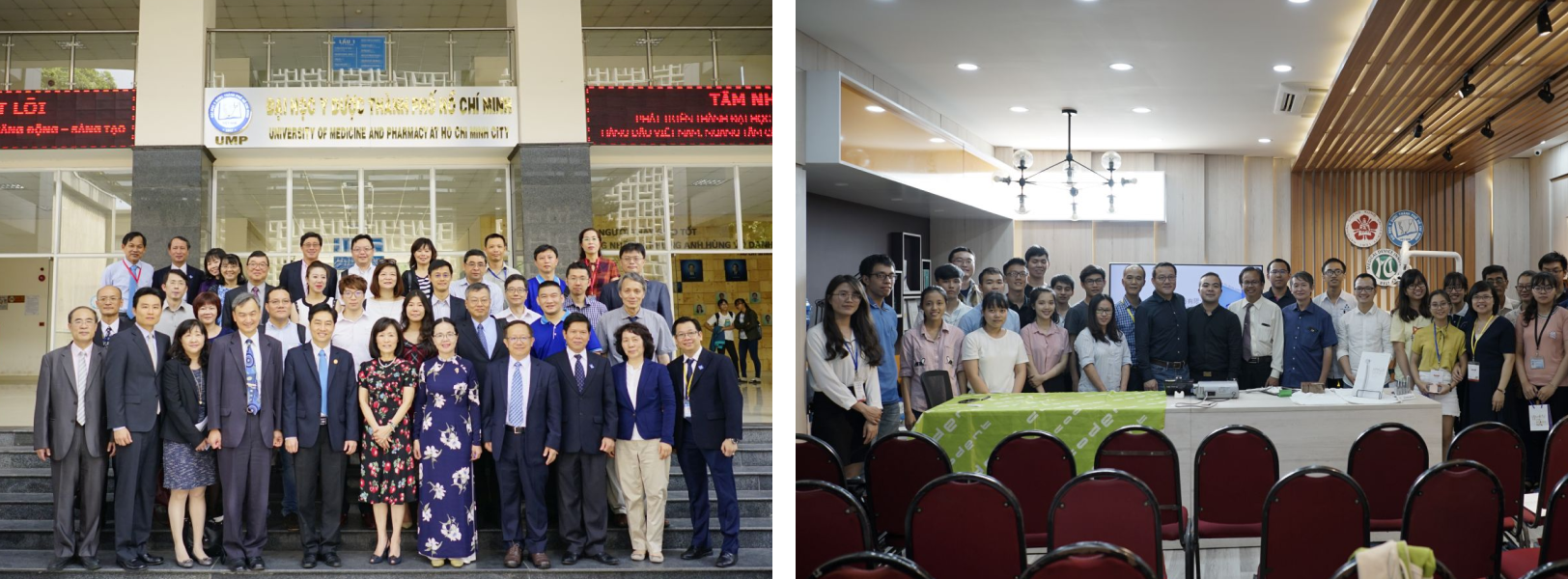
(L) Opening of the UMP-NCKU Joint Research Center ; (R) Holding a Medical Device Training Workshop
(Credit: © NCKU - Medical Device Innovation Center)
Taipei Veterans General Hospital (VGHTPE)
In 2018, under the New Southbound Policy, the Ministry of Health and Welfare launched the One Country, One Center initiative. Taipei Veterans General Hospital formed a team to carry out this project by partnering with National Yang Ming Chiao Tung University, Taichung Veterans General Hospital, and Kaohsiung Veterans General Hospital. Since 2018, this partnership has signed a Memoranda of Understanding (MoU) with 24 Vietnamese institutions. In 2023, this initiative promoted further smart healthcare cooperation by hosting 50 technology professionals from Vietnam and Singapore.
The participants toured the Taipei Veterans General Hospital Heavy Ion Therapy Center and learned about the operational models of the hospital's electronic pharmacy and cancer care systems. They also held exchanges with healthcare professionals from both countries who were interning at the hospital. Because participants observed that Taiwan’s medical systems were more developed than theirs, visitors from Malaysia and Vietnam expressed interest in further collaboration with Taipei Veterans General Hospital to establish related medical infrastructure. This cooperation would allow patients in need to be referred to Taipei Veterans General Hospital for higher-quality medical care. (Taipei Veterans General Hospital, 2018) (Taipei Veterans General Hospital, 2023)
International Collaboration
India
In September 2021, the Vietnamese Ministry of Health and the Indian Ministry of Health and Family Welfare held an online Director General-level Joint Working Group (JWG) meeting to share approaches and perspectives in medicine. This working group meeting stemmed from a Memorandum of Understanding (MoU) signed between the two countries in September 2016. The meeting occurred during the COVID-19 pandemic, which was a crucial moment for international cooperation. The JWG included in-depth discussions on cooperation in areas such as digital healthcare, disease management, pharmaceuticals, and medical devices as well as the promotion of conventional medicine and public health strategies. (Embassy of India, Hanoi, 2021)
As early as 2018, Vietnam and India showed a strong interest in medical-related cooperation. Vietnam believed that India could provide high-quality yet relatively affordable pharmaceuticals. At that time, India was Vietnam's second-largest supplier of medicine, with imports reaching US$80 million. In 2017, Vietnam also relied on imports for 95% of its medical equipment, spending US$816 million on equipment, a figure that has been increasing by 15% annually. Thus, this substantial demand has laid a solid foundation for medical cooperation between India and Vietnam. (VeitnamPlus, 2018)
Australia
Starting in November 2023, Vietnam and Australia initiated discussions on digital healthcare cooperation. The two countries had previously engaged in healthcare collaboration during the COVID-19 pandemic. To fight the pandemic between 2020 and 2024, Australian public and civic groups donated approximately AUD$18.3 million and 26.4 million vaccine doses to Vietnam. From 2023 to 2024, Vietnam and Australia further expanded their digital healthcare cooperation. During a symposium in which the two countries explored potential future developments in digital healthcare, Vietnamese Deputy Minister of Health Trần Văn Thuấn stated that Vietnam's healthcare industry had launched various IT applications and digital transformation projects to protect, educate, and improve the overall health and well-being of its people. Deputy Minister Thuấn also called for the digitization of all healthcare-related information that covers workforce, resource, licensing, and registration procedures. In addition, Deputy Minister Thuấn highlighted the need to focus on information security during the digitization process. (CCH, 2023) (OpenGov, 2023) (HIMSS, 2023) (DFAT, ND)
Singapore
In February 2022, Singapore and Vietnam reaffirmed their commitment to strengthening their strategic partnership and cooperating on post-pandemic recovery efforts. During the meeting, the two countries exchanged views on various bilateral agreements in areas such as defence, the economy, digital technology, education, and intellectual property. In terms of healthcare cooperation, both sides emphasized the need to partner in fighting the pandemic while supporting each other with medical supplies. During the meeting, both sides also specifically mentioned partnering on post-pandemic recovery efforts once COVID-19 had subsided. (MFA, 2022)
Thailand
In March 2024, a delegation consisting of members from Vietnam Social Security (VSS), the Vietnamese Ministry of Health (MoH), and the World Bank Vietnam participated in a four-day training and study visit to the Thai National Health Security Office (NHSO) to learn about Thailand’s Diagnosis Related Group (DRG) payment reforms. VSS and the MoH have been working closely with Thailand on this topic, including collaboration with the Thai CaseMix Center (TCMC) and NHSO, to develop Vietnam’s own DRG system. Vietnam stated that the goal of the DRG payment system is to create a transparent payment structure which enables patients and insurance companies to better understand medical costs and pay fairer amounts. (NHSO, 2024)
Vietnam's Policy on Healthcare & Medicine
| Agency | Policy, Strategy, Project & Initiative |
|---|---|
| Prime Minister of Vietnam | |
| Ministry of Health (MoH), Vietnam |
Decision 5316/QD-BYT - Approving Medical Digitalization until 2025 with an Orientation to 2030 Decision 4888/QD-BYT - National Agenda for e-health Adoption Circular No. 49, 2017 - Regulating the Management of Telemedicine Electronic Medical Records (EMR) |
| Ministry of Health and Welfare (MOHW), Taiwan | |
| Ministry of Health Research Institutes (NHRI), Taiwan | Asia-Pacific Network for Enterovirus Surveillance (APNES) |
|
National Cheng Kung University (NCKU) University of Medicine and Pharmacy (UMP) |
UMP-NCKU Joint Research Center |
Keywords: #Vietnam #Healthcare #Medicine
Reference / Sources:
Vietnam Sources
-
Vietnam Law & Legal Forum Magazine (2024.02) National Strategy for people’s health protection approved
-
VietnamPlus (2024.01) New national strategy eyes quality healthcare services for all
-
baochinhphu (2024.01) National strategy on people’s health released
-
Vietnam Investment Review (2022.03) Accelerating the vital digital transformation of hospitals
-
VietnamPlus (2021.04) Medical records to be connected nationwide from July 1
-
vanbanphapluat (2020.12) Nội dung toàn văn Decision 5316/QD-BYT 2020 Medical digitalization program until 2025 and orientation to 2030
-
THƯ VIỆN PHÁP LUẬT (2019.10) INTRODUCING THE SCHEME FOR APPLICATION AND DEVELOPMENT OF SMART HEALTHCARE INFORMATION TECHNOLOGY FOR THE 2019 - 2025 PERIOD
-
Ministry of Health (2019.10) Bộ Y tế phê duyệt Đề án phát triển công nghệ thông tin y tế thông minh giai đoạn 2019-2025
-
VietnamPlus (2018.08) Vietnam, India eye high cooperation potential in pharmaceuticals: diplomat
-
LawNet (2017.12) Circular No. 49/2017/TT-BYT dated December 28, 2017 on telemedicine
Foreign Sources
-
泰國國家健康安全辦公室 National Health Security Office (2024.03) Vietnam Social Security and Health Ministry Delegates Visit NHSO for Extensive DRG Training
-
新加坡外交部 Ministry of Foreign Affairs - Singapore (2022.02) Joint Press Statement Between the Socialist Republic of Vietnam and the Republic of Singapore on Strengthening Strategic Partnership and Recovery Cooperation
-
駐河內印度大使館 Embassy of India in Hanoi (2021.09) India-Vietnam Joint Working Group Meeting on Health Cooperation
-
澳洲外交及貿易部 Department of Foreign Affair and Trade (N.D.) Development assistance in Vietnam
-
United States Agency for International Development (N.D.) Vietnam Health
Other Sources
-
The College of Contemporary Health (2023.12) Vietnam and Australia join forces to accelerate digital health transformation
-
OpenGov (2023.11) Vietnam, Australia Collaborate on Digital Healthcare
-
Healthcare IT News, HIMSS Media (2023.11) Vietnam, Australia explore cooperation in digital health transformation
-
Healthcare IT News, HIMSS Media (2019.06) Vietnam to deploy EHR nationwide in July
-
Tilleke & Gibbins International Ltd. (2018.01) Vietnam Issues Regulations on Telemedicine
-
WHO Vietnam
Domestic Sources
-
工商時報(2023.03) 新南向以醫帶商 拚創百億產值
-
國家衛生研究院電子報 (2022.10) 2022年執行衛生福利部新南向國際合作計畫參訪紀實
-
國立成功大學國際事務處 (2021.12) 海外基地簡介
-
國家衛生研究院電子報 (2021.11) 台越國際合作:國衛院與越南震興醫院簽署合作備忘錄
-
台北榮民總醫院 (2018.07) TVGH signed MOU with four Vietnamese hospitals
-
衛福部 (2018.06) 「一國一中心」開創新南向醫衛產業合作新動能
-
國立成功大學海外科研基地 (N.D.) Introduction Study in Vietnam
-
台北榮民總醫院 (N.D.) One Country One Center - Vietnam

