

Vietnam, which is located in the Mekong River basin of Mainland Southeast Asia, is an important country in the region. Due to the pollution caused by domestic economic development, Vietnam has been pursuing various avenues of sustainability in recent years. Through various initiatives and policies related to environmental protection, energy, digital transformation, and international cooperation, Vietnam aims to align with the international community’s goal of achieving net-zero emissions by 2050.
Section:|Overview|Agencies|Policies & Strategies|VN-Taiwan|International Collaboration|Table|
Overview
Vietnam, as an important country in Mainland Southeast Asia, is rich in natural resources. However, like many developing countries, it faces challenges such as environmental degradation and the impacts of climate change. The economic shocks of the COVID-19 pandemic caused Vietnam to place a higher importance on national sustainable development. As investors increasingly prioritize sustainability, governments worldwide are gradually leveraging policies and international cooperation to promote sustainable development and transformation for their own economic growth.
Following the pandemic, the Vietnamese government started formulating plans to align with global sustainability trends. At the 13th National Congress of the Communist Party of Vietnam in 2021, the government set out its development plan for 2021 to 2030 in the “Information and Communication Infrastructure Master Plan for the Period 2021-2030, with a Vision to 2050”. Following this, Vietnam approved a series of sustainability-related policies, including the “National Action Plan on Green Growth for the 2021-2030 Period,” “Power Development Plan 8 (PDP8)”, “Power Capacity from Renewable Energy Sources by 2030,” and “Information and Communication Infrastructure Master Plan for the Period 2021-2030, with a Vision to 2050”.
In addition to emphasizing how Vietnam will leverage sustainable development to enhance its economy and digitalization efforts, these policies also express a commitment to balancing national sustainable development with protecting the rights of disadvantaged groups.
After Thailand’s Bio-Circular-Green (BCG) economic policy garnered attention at APEC, Vietnam, as the host nation for APEC in 2027, hopes to continue this momentum by developing its own sustainable economy. Therefore, Vietnam is pursuing cooperation with various countries involved in the New Southbound Policy while also striving to acquire technology and funding by partnering with developed nations, such as Australia, New Zealand, and Singapore.
In addition, Vietnam recognizes the impact of its neighboring countries, whether they share land borders or are separated by seas. Therefore, Vietnam is actively working with countries such as Indonesia, the Philippines, and Malaysia on issues including marine environments and agricultural development.
In terms of sustainable development, Vietnam highly values its partnership with Taiwan. For instance, Vietnam seeks Taiwan's assistance in technical knowledge acquisition and academic research collaboration. In addition to research and technical cooperation in the regeneration and reuse of agricultural waste, Taiwanese businesses have gradually started investing and working in Vietnam because they recognize the country’s potential for sustainable development. As Vietnam continues to promote sustainability, Taiwanese research teams will most likely have even more opportunities to cooperate with Vietnam.
Agencies
- Prime Minister
- Ministry of Planning and Investment (MPI)
- Ministry of Information and Communication (MIC)
Policies & Strategies
Power capacity from Renewable Energy Sources by 2030
In April 2024, Vietnam's Deputy Prime Minister Trần Hồng Hà signed Decision No. 262/QD-TTg, which approved the “Power Capacity from Renewable Energy Sources by 2030” implementation plan. The Vietnamese government aims to mitigate environmental pollution and greenhouse gas emissions by transitioning from fossil fuels to new and renewable energy sources. By 2030, this policy aims to install offshore wind power, onshore wind power, hydropower, and biomass energy with power generation capacities of 6,000 MW, 21,800MW, 29,346MW, and 1,088MW, respectively.
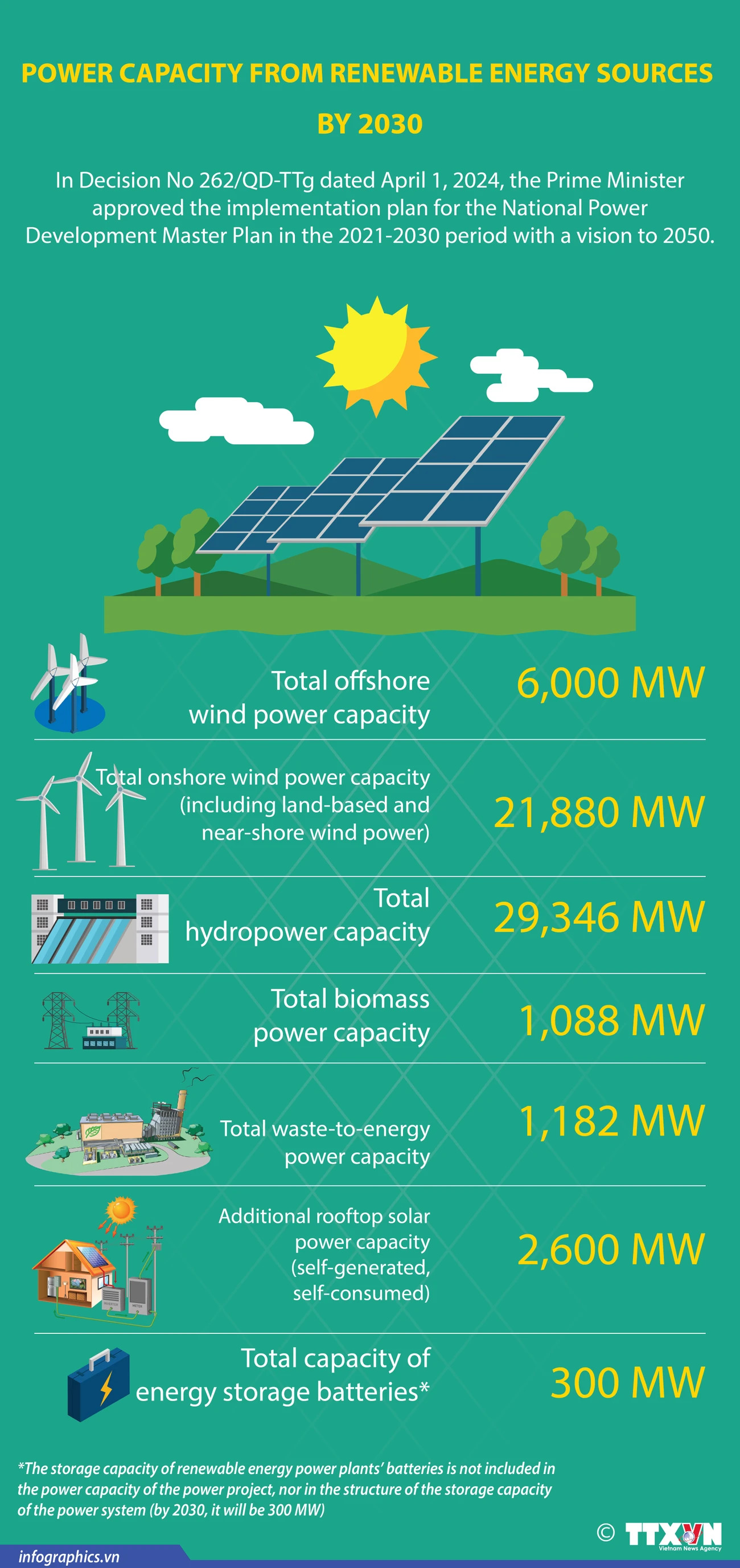
Source: “Power Capacity From Renewable Energy Sources by 2030” Infographic © Vietnam Plus
Information and Communication Infrastructure Master Plan for the Period 2021-2030, with a Vision to 2050
In January 2024, Vietnam's Prime Minister issued Decision No. 36/QD-TT, officially approving the “Information and Communication Infrastructure Master Plan for the Period 2021-2030, with a Vision to 2050”. In February of the same year, the Ministry of Information and Communications of Vietnam drafted a more detailed version of the plan. This comprehensive plan for the country's ICT infrastructure focuses on driving Vietnam’s digital transformation by establishing broadband communication infrastructure, high-speed internet, investment in international telecommunication cables, transitioning to IPv6 technology by 2025, creating green data centers, and developing specialized IT parks.
Establishing green data centers is a key focus of these initiatives. Vietnam aims to have at least three national-level digital data centers and several regional data centers by 2025. In addition to providing the necessary infrastructure for data storage and processing, these green data centers aim to contribute to environmental sustainability by minimizing energy consumption and carbon emissions. (Vietnam Briefing, 2024)
Power Development Plan 8, PDP8
In May 2023, Vietnam's Deputy Prime Minister Trần Hồng Hà approved the “Power Development Plan 8” (PDP8), which includes the development of power sources and transmission networks of 220 kV and above, as well as a renewable energy industry and related services by 2030. The plan also stresses offering potential opportunities to foreign energy companies due to the substantial investment required for developing the energy industry.
The outlined goals stated that Vietnam should do its best to adopt renewables, develop green energy, and create an industry ecosystem with renewable energy services. By 2030, Vietnam also aims to establish two interregional renewable energy and industrial service centers. The plan’s targets include an increase in renewable energy usage to between 67.5% and 71.5% by 2050. Additionally, it aims to cap greenhouse gas emissions from electricity generation at 204 to 254 million tons by 2030 and 27 to 31 million tons by 2050.
The plan also seeks to ensure national energy security, meet domestic electricity demand, and more than double Vietnam’s power generation capacity—from 69 GW at the end of 2020 to over 150 GW by 2030. Furthermore, Vietnam aims to become an exporter of green electricity by producing 5 GW to 10 GW of green power by 2030.
National Action Plan on Green Growth for the 2021-2030 Period
In July 2022, Vietnam's Prime Minister approved Bill No. 882/QD-TTg, which ratified the Ministry of Planning and Investment’s “National Action Plan on Green Growth for the 2021-2030 period”. This plan addresses a wide range of issues that encompass all aspects of the country's green development. It states that the government should focus on protecting the rights of disadvantaged groups during the process of sustainable development by establishing relevant comprehensive policy frameworks.
As Vietnam develops a green economy, the plan highlights the importance of issues such as managing risks related to natural disasters, adapting to climate change, and protecting the environment. Additionally, the plan calls for promoting a circular economy by advancing research and development in comprehensive solid waste management models and waste treatment technologies.
In terms of successful implementation, the plan also stresses the need for industrial financial investments and international cooperation while pursuing green development.
National Green Growth Strategy for 2021-2030, Vision Towards 2050
In 2021, Vietnam's former Deputy Prime Minister Lê Văn Thành signed Decision No. 1658/QD-TTg, which approved the “National Green Growth Strategy for 2021-2030, Vision Towards 2050”. This strategy states that green growth facilitates economic restructuring, updates growth models, enhances competitiveness, and strengthens resilience to external shocks. It supports the implementation of the socioeconomic development scheme of the “National Master Plan for 2021-2030”, as well as the development strategies for various industrial sectors. In addition, the strategy is a key pathway to achieving sustainable development. In the long term, the strategy directly contributes to reducing greenhouse gas emissions and promoting a carbon-neutral economy.
To promote green growth, the strategy focuses on investing in advanced technologies, digital transformation, and smart and sustainable infrastructure. This strategy will create momentum that makes private investment play an increasingly important role in the green economy. The aforementioned bill, which sets specific goals for each individual government agency, has the Ministry of Planning and Investment play a pivotal role in leading its overall implementation. The bill has also tasked the Ministry of Planning and Investment with acting as the national coordination center for affairs related to green growth.
Collaboration: Taiwan and Vietnam
National Science and Technology Council (NSTC)
YunTech-VNUHCM
In 2019, the National Yunlin University of Science and Technology (YunTech) signed a memorandum of understanding with the Ho Chi Minh City University of Science (VNUHCM-US), which launched various industry-academia cooperation and exchange initiatives. With support from the National Science and Technology Council, the two universities jointly established the “Taiwan-Vietnam Environmental Protection Overseas Science and Technology Innovation Center” (TVEPOC) in 2020. The team's research primarily focuses on supporting technology development in areas such as:
- Water: drinking water and wastewater treatment
- Soil: remediation of contaminated soil
- Air: mobile pollution sources and stationary pollution sources
- Chemicals: chemical inspection methods, applied hazard management, and chemical accidents.
Since being established in 2020, TVEPOC has facilitated collaboration in at least nine different fields of research. The center has also further promoted industry-academia cooperation between Vietnam and Taiwan by offering separate courses for both professional and non-professional researchers.
Image credit: © Taiwan-Vietnam Environment Protection Overseas Science and Technology Innovation Center)
VAAS-NCHU
In 2017, the National Science and Technology Council (NSTC) provided National Chung Hsing University (NCHU) with funding to establish the “VAAS-NCHU Agricultural Science and Technology Innovation Cooperation Center”. NCHU has a leading global position in tropical and subtropical agricultural research and has been a key player in Taiwan's agricultural technology foreign aid for many years.
In addition to assisting the Association of Southeast Asian Nations (ASEAN) promote modern agricultural biotechnology through technology transfer, this center also positions Southeast Asia and South Asia as key international markets for Taiwan’s agricultural biotechnology exports and industrial deployment.
NCHU specifically selected Vietnam as a partner for this project, given the university’s strong relationship and solid collaborative foundation with the Vietnam Academy of Agricultural Sciences (VAAS). NCHU also aims to further deepen collaboration with Vietnam by actively aligning with Taiwan's New Southbound Policy.

Image credit: © VAAS-NCHU Agricultural Science and Technology Innovation Cooperation
This project, which designates the NCHU Biotechnology Center and the VAAS International Science and Technology Center as implementation authorities, integrates NCHU's strengths in agriculture, biotechnology, and related top-tier talent. These strengths include modern scientific technologies in the plant protection industry, such as biological fertilizers, biopesticides, soil disease control, viral disease control, as well as cutting-edge industrial technologies in food processing and health food.
By leveraging Vietnam's agricultural science agencies and agricultural universities affiliated with VAAS, the project also aims to establish a collaborative platform in key areas that strengthens bilateral scientific research, talent exchange, and training. NCHU's center at VAAS will help Vietnam create a modern agricultural biotechnology industry and serve as a model for Taiwan’s promotion of agricultural biotech technologies and expansion into international markets across the ASEAN region.
Taiwan ICDF
In April 2024, the International Rice Research Institute (IRRI) and the Vietnamese government invited the International Cooperation and Development Fund (ICDF) from Taiwan to participate in the launch of the “One-Million Hectare High-Quality Low-Carbon Rice in the Mekong Delta Program,” which was held in Thành phố Long Xuyên, Vietnam. This project is part of a World Bank loan initiative. The focus of the ICDF's collaboration with IRRI on the “Capacity Building for Sustainable and Low-Carbon Rice Innovations in Southeast Asia (CABIN) project” in Vietnam is to serve as the technical partner for this loan project.
In the future, to meet local demand for post-harvest rice straw management, the ICDF will support the sustainable development of low-carbon rice cultivation in Vietnam and complement IRRI's existing research results by introducing Taiwan's rice cultivation technologies and the practical experience of Taiwan's overseas technical teams (Reccessary, 2024)
NCCU
In July 2024, National Chengchi University College of Social Sciences Center for Sustainability Planning Director Chen-Yi Sun, attended the “New Horizons for Investment in Vietnam—Industrial Zone Investment Seminar,” which was held jointly by the Commerce Development Research Institute and Vietnam’s SHINEC Joint Stock Company. At the seminar, Director Sun discussed sustainable industrial zone planning with SHINEC Chairman Phạm Hồng Điệp. During the seminar, representatives from SHINEC presented a briefing on the Nam Cầu Kiền Industrial Park, which incorporates a broad range of concepts from renewable energy and water to recycling, the circular economy, and ESG (Environmental, Social, and Governance). In addition to inviting businesses to set up factories in Vietnam, SHINEC also expressed the desire to partner with Taiwanese technology companies in areas related to environmental protection, energy optimization, and water resources to jointly create an exemplary eco-industrial park.
In exchanges after the seminar, Director Sun noted that Vietnam's economy is developing rapidly. In addition to the Nam Cầu Kiền Industrial Park, Vietnam currently is planning, constructing and seeking investment for several other industrial parks, which include An Dương (Hải Phòng), Tam Hà (Quảng Ninh Province), and along the Vũng Tiên River. Sun also expressed that he looks forward to the NCCU College of Social Sciences Center for Sustainability Planning continuing to balance industrial development with environmental protection by holding discussions and working with SHINEC. (TaiSounds, 2024)
Private Sector Cooperation
In addition to government agencies, Taiwanese businesses have established many close ties with Vietnam. For example, in March 2024, the Taiwan Environmental Manufacturers Association (TEMA) signed a memorandum of understanding (MOU) with the Vietnam Waste Recycling Association (VWRA). In addition to serving as an important milestone for the environmental industry under the New Southbound Policy, TEMA Chairman Hung-Ju Chen mentioned during his opening remarks that this MOU will create new opportunities for cooperation between Taiwan and Vietnam in environmental protection.
Chen also stated that this collaboration symbolizes a shared commitment between Taiwan and Vietnam. Additionally, by recognizing each other’s strengths in terms of industrial information, Chen said this MOU will facilitate bilateral technical exchanges, experience sharing, and joint development. In conclusion, Chen stated that such cooperation will create mutual benefits in the environmental industry by having both countries aim to work together toward achieving net-zero carbon emissions and renewable circularity while contributing to global sustainability. (TEMA, 2024)
In April 2024, Taiwan’s Lian Tat Company teamed up with the Vietnam Industrial Park Finance Association (VIPFA), the Southeast-Asia Impact Alliance (SIA), and DVL IPT Investment Promotion and Trade Joint Stock Company (DVL IPT) to sign a memorandum of understanding for cooperation on creating an industrial park solutions platform. This partnership aims to assist Vietnam’s industrial parks in moving towards sustainable operations by introducing Taiwan's top industrial park solution technologies from five key areas: renewable energy solutions, smart city solutions, energy-saving and carbon reduction solutions, wastewater treatment solutions, and waste management solutions. (EDN, 2024)
International Collaboration
Thailand
In terms of sustainability, Vietnam and Thailand have engaged in numerous collaborations throughout the public and private sectors. In April 2024, Vietnam's Minister of Foreign Affairs Bùi Thanh Sơn and Thailand's former Minister of Foreign Affairs Parnpree Bahiddha-nukara (who stepped down in May 2024) stated at the 5th Thailand - Viet Nam JCBC Meeting that the two nations would establish a joint working group to formulate and implement the “Three Connections” strategy. This strategy aims to plan potential cooperative projects that focus on supply chains, energy transition, the development of an electric vehicle ecosystem, and high-tech agriculture.
The “Three Connections” strategy, which was approved by both governments in November 2022, focuses on connecting supply chains, linking key economic sectors—particularly micro-, small, and medium-sized enterprises (MSMEs) and local businesses—while aligning Vietnam and Thailand’s sustainable growth strategies, which include Vietnam's National Green Growth Strategy and Thailand's Bio-Circular-Green (BCG) Economic Model.
In March 2024, Vietnam Trade Office in Thailand Head Lê Hữu Phúc stated that bilateral green cooperation will open up new business opportunities because Thailand is Vietnam's largest trade partner within ASEAN. (Hanoi Times, 2024) (netzero, 2024)
ThaiBev, the largest food and beverage producer in ASEAN, provided evidence of private sector cooperation by participation in the “Vietnam Circular Economy Forum 2023”. During the event, ThaiBev expressed its commitment to continuing the development of the circular economy in Vietnam, based on its long-standing principle of achieving packaging circularity while considering all environmental and social impacts. (Vietnam Invest Review, 2023)
Malaysia
Green cooperation between Vietnam and Malaysia is primarily based on bilateral trade and investment. In May 2024, the Trade Counselor of Vietnam in Malaysia Lê Phú Cường stated that Vietnam and Malaysia have complementary strengths and ample opportunities for cooperation in emerging sectors such as digital transformation, semiconductors, artificial intelligence, and electric vehicle production.
As early as August 2023, during the “Vietnam-Malaysia Business Forum,” Prime Minister Anwar Ibrahim expressed Malaysia's commitment to promoting sustainable and environmentally friendly plans for economic growth. As such, Ibrahim expressed his hope that Vietnam would strengthen cooperation with Malaysia in these areas. During the same forum, Vietnam Chamber of Commerce and Industry Vice President Nguyễn Quang Vinh also suggested that both countries should enhance cooperation in areas such as improving supply chain resilience and support for small and medium-sized enterprises (SMEs), including micro, small, and medium enterprises, and their Environmental, Social, and Governance (ESG) frameworks. (Viet Nam News, 2024) (VCCI, 2023)
Philippines
In January 2024, Vietnamese Prime Minister Phạm Minh Chính expressed that the Vietnamese government is committed to supporting and creating favorable conditions for Philippine companies to successfully establish themselves in Vietnam by ensuring sustainable development and long-term investment in accordance with national regulations. Meanwhile, the President of the Philippines suggested that both countries continue to develop cooperation in conventional economic sectors, as well as in non-conventional fields such as mining, green technology, transportation, and technology.
In terms of avenues of cooperation, Vietnamese companies are looking to collaborate with their Philippine counterparts in areas such as digital transformation, green transition, high-tech industries, and food processing. At the same time, the Philippines hopes to work with Vietnam in sectors such as electric vehicle production, infrastructure, telecommunications, energy, food, pharmaceuticals, agriculture, and retail.
In addition, the two countries have also held discussions on agriculture because Vietnam is the largest rice exporter to the Philippines. As such, Vietnam hopes to position itself as a transparent, responsible, and sustainable food supplier in the future by further strengthening agricultural cooperation with the Philippines. (Vietnam Plus, 2024) (Hanoi Times, 2024)
Indonesia
In January 2024, during Indonesian President Joko Widodo's state visit to Vietnam, Vietnam's Minister of Industry and Trade Nguyễn Hồng Diên and Indonesia's Minister of Industry Agus Gumiwang Kartasasmita reached an agreement on bilateral cooperation in the electric vehicle (EV) sector. Both ministers agreed that Vietnam could partner with Indonesia to develop an EV ecosystem, which includes collaboration on EV battery production, sustainable mining for green development, and carbon credit trading.
Vietnam is currently developing a sustainable industrial ecosystem and has implemented policies to promote areas such as high-tech investment, innovation, research and development, digital transformation, energy transition, green industries, and digitalization, and greater participation of Vietnamese businesses in the value chain. Indonesia's Minister of Industry noted that Indonesia has opportunities for further cooperation with Vietnam because the two countries share similar development needs and strengths. (Hanoi Times, 2024)
In addition, Indonesian President Joko Widodo and Vietnamese Prime Minister Phạm Minh Chính held high-level talks with business leaders from both Vietnam and Indonesia. According to President Widodo, talks with the business community serve as an important platform to explore opportunities for sustainable economic growth and lay the groundwork for strengthening cooperation in optimizing Indonesia’s carbon market, which has a potential value that exceeds $200 billion.
This cooperation is expected to have a significant positive impact on mitigating climate change while protecting the environment, promoting green economic activities, and improving overall social well-being. (Fairatmos, 2024)
Singapore
In February 2023, Vietnam and Singapore signed a “Green-Digital Economic Partnership”. Under this partnership, Singapore will support Vietnam in establishing digital platforms that drive digital transformation in prioritized areas such as banking and finance, e-commerce, population management, and land management. Additionally, Singapore will support Vietnam's transition to renewable energy while developing an interconnected power grid between the two countries.
Vietnam, on the other hand, will continue to create an environment that encourages Singaporean companies to invest in green energy, digital transformation, and science and technology. Vietnam also hopes that, in addition to investing in the already established “Vietnam-Singapore Industrial Parks” (VSIP), which focus on smart, green, and energy-efficient industries, Singapore will open more similar parks outside of central Vietnam. (VIET NAM Government News, 2023) (HTDC, 2023)
In August 2023, Singapore and Vietnam further signed a “Sustainable Development and Innovation Agreement,” which aims to expand the scope of bilateral economic cooperation by strengthening partnerships in innovation, energy interconnectivity, and sustainable development. Singaporean Ambassador to Vietnam Jaya Ratnam mentioned in two previous interviews in February and May that the agreements signed between Singapore and Vietnam would help both countries gain an advantage in the carbon market.
Singapore is also planning to expand its renewable energy investments in the ASEAN region by launching a financial platform—the Financing Asia's Transition Partnership (FAST-P)—with the goal of raising US$5 billion to support climate action in Asia. (CNA, 2023) (Vietnam Plus, 2024) (VnEconomy, 2024)
In May and July 2024, Singapore and Vietnam reaffirmed their commitment to continue cooperation in the green digital economy. In May, Singapore expressed its intention to assist Vietnam in achieving energy transition and improving power connectivity while promoting digital transformation in key sectors such as banking and finance, e-commerce, land, and population management.
During the visit of Singapore’s Deputy Prime Minister to Vietnam in July, both countries reiterated the need to set concrete goals and plans to advance cooperation in the green digital economy. Both sides also encouraged their respective ministries of education to cultivate talent capable of driving scientific and technological transformation by strengthening cooperation in education and training. (Hanoi Times, 2024) (Vietnam Plus, 2024)
Australia
Australia and Vietnam have extensive official cooperation on green issues. Currently, the Monash University Climateworks Centre, an Australian non-profit organization established in Australia, has launched the “Australia-Vietnam Green Economy Program”. This initiative, which is supported by Australia's Department of Foreign Affairs and Trade, aims to unlock the potential of the green economy by focusing on sustainable development, job creation and growth, and net-zero economic transition driven by renewable resources. (Climateworks Centre, 2022)
In May 2023, Australia launched the “Future of Electricity—Vietnam” (FE-V) program, which is aimed at strengthening bilateral connections between energy and climate institutions by enhancing their knowledge and efficiency. (Australian Embassy Vietnam, 2023)
In the same year, Australia and Vietnam established the “Australia-Vietnam Partnership for Economic Growth” initiative. Additionally, in August 2023, Australia provided AUD$94.5 million in funding to support climate change adaptation in the Mekong Delta region. (Vietnam Briefing, 2024)
In March 2024, Australia and Vietnam officially elevated their bilateral relationship to a Comprehensive Strategic Partnership, with key focuses on green energy and climate change. In April 2024, during the “Australia-Vietnam Green Economy Summit,” both countries pledged to strengthen cooperation in climate and energy. Climateworks Centre CEO Anna Skarbek stated that Vietnam has become an increasingly attractive place for green economy investments as the country seeks to promote a long-term net-zero transition. (Viet Nam News, 2024) (Vietnam Plus, 2024) (Power Technology, 2024)
New Zealand
New Zealand views Vietnam as an important trade partner within ASEAN. Thus, the two countries established a strategic partnership in 2020. New Zealand frames its relationship with Vietnam within the context of its broader relationship with ASEAN. As such, New Zealand helps Vietnam promote sustainable economic growth by supporting economic and climate initiatives. (MFAT, N.D.)
In March 2024, Vietnamese Prime Minister Phạm Minh Chính visited New Zealand. During the visit, New Zealand Prime Minister Christopher Luxon expressed that New Zealand would continue to invest in Vietnam's agriculture and environmental protection. Vietnamese officials stated they anticipate breakthroughs in new areas of bilateral cooperation that include, science and technology, innovation and entrepreneurship, the green economy, the digital economy, the circular economy, environmental technology transfer, emissions reduction, agriculture, artificial intelligence, and semiconductors. (Vietnam Law & Legal Forum, 2024) (VNExpress, 2024) (VIET NAM Government News, 2024)
Vietnam and New Zealand's cooperation on sustainability extends beyond high-level talks. In January 2024, Vietnamese Deputy Minister of Natural Resources and Environment Lê Công Thành held a working meeting with former New Zealand Ambassador to Vietnam Trenede Dobson to discuss cooperation in climate change. During the discussion, Deputy Minister Thành stated that Vietnam hoped New Zealand could help government agencies establish a legal framework that would assist Vietnam in creating a domestic carbon market. In turn, New Zealand noted that its parliament was supporting climate change adaptation and resilience efforts in countries throughout the Asia-Pacific region by approving a funding commitment of NZD$1.3 billion from 2022-2025. (Vietnam Plus, 2024)
Vietnam's Policy on Energy & Sustainability
| Agency | Policy, Strategy, Project & Initiative |
|---|---|
| Prime Minister |
Decision 262/QD-TTg (Power capacity from renewable energy sources by 2030) Power Development Plan 8 (PDP8) Partnership in Digital Economy–Green Economy (Vietnam-Singapore) Sustainable Development and Innovation Agreement (Vietnam-Singapore) |
| Ministry of Planning and Investment |
Decision 882/QD-TTg (National Action Plan on Green Growth for the 2021-2030 period) Decision 1658/QD-TTg (National Green Growth Strategy for 2021-2030, vision towards 2050) |
| Ministry of Information and Communications |
Decision 36/QD-TT (Information and Communication Infrastructure Master Plan for the Period 2021-2030, with a Vision to 2050) |
|
National Science and Technology Council (NSTC) National Yunlin University of Science & Technology (YunTech) University of Science, Viet Nam National University Ho Chi Minh City (VNUHCM-US) National Chung Hsing University (NCHU) Vietnam Academy of Agricultural Sciences (VAAS) |
Taiwan- Vietnam Environmental Protection Overseas Science and Technology Innovation Centre (TVEPOC) VAAS-NCHU Agricultural Science and Technology Innovation Cooperation (VAAS-NCHU STIC) |
| Taiwan ICDF | One-Million Hectare High Quality Low-Carbon Rice in the Mekong Delta Program |
|
Vietnam Government Australian Government |
Australia-Vietnam Green Economy Program Future of Electricity—Vietnam (FE-V) |
Keyword: #Vietnam #Energy #Sustainability
Reference / Sources:
Vietnam Sources
-
SOCIALIST REPUBLIC OF VIET NAM Government News (2021.10) National Green Growth Strategy for 2021-2030, vision towards 2050
-
vietnam.gov.vn (2024.04) Quyết định số 262/QĐ-TTg của Thủ tướng Chính phủ: Phê duyệt Kế hoạch thực hiện Quy hoạch phát triển điện lực quốc gia thời kỳ 2021 - 2030, tầm nhìn đến năm 2050
-
vietnam.gov.vn (2021.01) Quyết định số 1658/QĐ-TTg của Thủ tướng Chính phủ: Phê duyệt Chiến lược quốc gia về tăng trưởng xanh giai đoạn 2021 - 2030, tầm nhìn 2050
-
Vietnam Briefing (2024.04) Vietnam’s National Electricity Development Plan 2021-2030: Roadmap Approved
-
Vietnam Briefing (2024.04) Vietnam’s National Electricity Development Plan 2021-2030: Roadmap Approved
-
Vietnam Plus (2024.04) Power capacity from renewable energy sources by 2030
-
Vietnam Briefing (2024.03) Vietnam’s Digital Infrastructure Master Plan to 2030: Roadmap to a High-Tech Future
-
Vietnam Briefing (2024.01) Information Communication Infrastructure Master Plan Approved
-
Hanoi Times (2024.04) Vietnam, Thailand advance realization of “Three Connections” strategy
-
Vietnam Invest Review (2023.11) ThaiBev pledges to develop circular economy in Vietnam
-
Viet Nam News (2024.05) Big opportunities remain for Vietnam and Malaysia to partner in new technology areas: Official
-
VCCI (2023.0) Further promote economic and trade cooperation between Vietnam and Malaysia.
-
Vietnam Plus (2024.01) Vietnam pledges support for Philippine investors
-
Hanoi Times (2024.01) Philippines sees Vietnam as key food security partner
-
Hanoi Times (2024.01) Vietnam, Indonesia to further cooperate in electric vehicle ecosystem
-
SOCIALIST REPUBLIC OF VIET NAM Government News (2023.02) Viet Nam, Singapore establish digital economy–green economy partnership
-
Vietnam Plus (2024.02) Singaporean Ambassador stresses three prominent areas for closer cooperation with Vietnam in 2024
-
VnEconomy (2024.05) Vietnam and Singapore Cooperation: Forward With Confidence
-
Hanoi Times (2024.05) Vietnam, Singapore take Green-Digital Economy Partnership to new heights
-
Vietnam Plus (2024.07) Vietnam, Singapore to promote cooperation in green, digital economy
-
Vietnam Law & Legal Forum (2024.03) PM delivers policy speech at Victoria University of Wellington
-
VNExpress (2024.03) PM urges New Zealand firms to boost investment in Vietnam
-
SOCIALIST REPUBLIC OF VIET NAM Government News(2024.03) Viet Nam, New Zealand plan to cooperate in achieving net-zero emissions by 2050
-
Vietnam Briefing (2024.03) Vietnam-New Zealand Investment and Trade Opportunities
-
Vietnam Plus (2024.01) Vietnam, New Zealand cooperate effectively in climate change responses
-
Vietnam Briefing (2024.02) Australia-Vietnam Collaboration on Sustainable Development
-
Viet Nam News (2024.04) Việt Nam, Australia vow to strengthen climate, energy co-operation
-
Vietnam Plus (2024.04) Vietnam, Australia vow to strengthen climate, energy cooperation
-
Power Technology (2024.04) Vietnam and Australia boost green energy collaboration
-
Vietnam Plus (2024.04) Ministry issues digital transformation plan for energy sector
- Vietnam Plus (2024.04) Meeting charts course for sustainable marine economy
Foreign Sources
-
紐西蘭外交及貿易部 New Zealand Foreign Affairs and Trade (ND) Viet Nam
-
澳洲駐越南大使館 (2023.05) Australia and Vietnam powering on together with clean energy transition
Other Sources
-
netzero (2024.03) Ample room for Vietnam-Thailand cooperation in new economic sectors: official
-
Fairatmos (2024.01) High-Level Discussion between Indonesia and Vietnam Sets the Stage for Sustainable Business Collaboration
-
經貿研究 (2023.03) VIET NAM: Green Economy Partnership Established with Singapore
-
Chennal New Asia (2023.08) Singapore and Vietnam expand scope of economic cooperation, sign deals on sustainability, innovation
-
Climateworks Centre Australia-Vietnam Green Economy Program
-
Food and Agriculture Organization of the United Nations (2022.07) Decision 882/QD-TTg in 2022 promulgated by the Prime Minister approving the National Action Plan on Green Growth for the 2021-2030 Period.
-
OpenGov Asia (2024.04) Vietnam’s Strategic Shift to Digital Energy Solutions
-
East Asia Forum (2024.05) Vietnam’s renewable surge shouldn’t distract from chronic environmental policy failures
-
World Economic Forum (2023.05) Vietnam's $135 billion power plan for 2030
-
The Nation (2024.01) Vietnam surges ahead of Thailand in 2024 global growth quality report
-
International Banker (2023.03) To Build a Sustainable Future: Vietnam and Thailand Court International Investment
-
UNDP (2023.12) Viet Nam's Steps Toward Sustainable Agriculture and Food Systems at COP28
-
Climate and Development Knowlege Network Vietnam’s National Green Growth Strategy
Domestic Sources
-
Reccessary (2024.04) 強強聯手新南向 國合會與研究單位推「東南亞永續低碳稻作專案」
-
中華民國對外貿易發展協會 (2024.04) 越南政府至2030年 再生能源發展計畫
-
太報 (2024.07) 政大社科院永續中心促台越工業園區永續發展
-
經濟日報 (2024.01) 引進台灣綠電及工業區解決方案 聯達行與越南工業園區金融協會簽署合作備忘錄
-
臺灣環保資源再生設備工業同業公會 (2024.03) 臺灣環保資源再生設備工業同業公會(TEMA)與越南廢棄物處理協會(VWRA)合作備忘錄MOU簽屬暨技術交流會議
-
僑務電子報 (2023.12) 越南臺資首間ESG典範工廠 與資策會合作啟航
-
Reccessary (2023.07) 一文掌握越南第八版「國家電力發展計畫」
-
駐越南台北經濟文化辦事處 (2024.07) 廢棄物轉換成能源專案需要加快,以解決環境汙染問題
-
台灣經貿網 (2022.08) 越南企業加強實施環境、社會及治理(ESG)策略
-
AQULIA 越南的綠色轉型:透過政策、金融和國際合作塑造永續的未來

