

During the 1960s, India founded the Indian Space Research Organisation (ISRO) and constructed their own launch facilities. In 2008, India became the fifth country to successfully land instruments on the Moon. In 2025, India partnered with NASA to launch a satellite. Currently, India is committed to developing surveying technology for planets. In the future, India hopes to construct a manned spacecraft.
Section:|Overview|Agencies|Policy|Achievements|Academic|India-Taiwan|International Collaboration|Table|
Overview
India is a leader in space technology. In the 1960s, India founded the Indian Space Research Organisation (ISRO) to facilitate the development of space technology. At the time, India had already established the Thumba Equatorial Rocket Launching Station (TERLS) and was conducting space research with Japan. Furthermore, India founded the Indian Institute of Space Science and Technology (IIST) to have the capacity to train more experts in space technology. (JAXA, 2007)
To date, India has achieved a range of significant accomplishments in the development of space technology. According to the Indian government, from 2018 to 2022, ISRO earned US$94 million by launching 144 satellites for 19 different countries. In addition to creating additional revenue, India launched its lunar polar exploration program at the end of the 20th century. This program eventually made India the fifth country to reach the Moon’s surface. During the mission, India established a solid foundation for subsequent lunar research by discovering the presence of water. This may provide the opportunity to facilitate technology development that can utilize water resources or ice layers on the Moon’s surface. (India Today, 2025) (The Times Of India, 2022)
Based on the success of its lunar expedition, India aims to achieve other accomplishments in exploring other planets of our solar system. In 2013, India’s Mars Orbiter Mission (MOM) launched a satellite that travelled for 300 days to reach Mars’s orbit. This mission, which generated important research findings, ended after 8 years when ground systems lost contact with relevant instruments. In 2023, India further highlighted its progress in space technology by launching a solar observation satellite. Currently, India is preparing an exploration program of Venus, which will pave the way for future studies of the planet. (The Times Of India, 2013) (BBC, 2023) (Deccan Chronicle, 2015)
Taiwan has also recognized India’s remarkable achievements in space technology. In 2022, the two countries demonstrated the potential for further cooperation when Taiwan partnered with SIA-India to launch a satellite. Taiwan aims to generate even more groundbreaking research by leveraging India’s strengths in space technology to identify further opportunities for collaboration with other participating countries of the New Southbound Policy. (CNA, 2022)
Related Agencies
- Department of Space (DoS)
- Indian Space Research Organisation (ISRO)
- Indian National Space Promotion & Authorisation Centre (IN-SPACe)
- NewSpace India Limited (NSIL)
In April 2023, the Indian Cabinet approved the Indian Space Policy 2023, which has primarily aimed to facilitate the overall development of India’s domestic industries related to space technology. In addition, this Policy hopes to strengthen India’s capabilities in aerospace, ensure a thriving sustainable space ecosystem, and promote the participation of private sector entities in industries related to space technology. According to the Policy, India’s strategy for developing its domestic space sector should focus on encouraging private sector integration into relevant industrial chains, encouraging R&D in aerospace, utilizing space technology to provide public products and services in areas of national importance, and establishing a stable regulatory framework through the Indian National Space Promotion & Authorisation Centre (IN-SPACe). The Policy also states that the Department of Space (DoS), the Indian Space Research Organisation (ISRO), and the Indian National Space Promotion & Authorisation Centre (IN-SPACe), and NewSpace India Limited (NSIL) are critical agencies for India’s aerospace development. According to the Policy, DoS is primarily responsible for policy formulation and coordination, ISRO should focus on applied research, R&D, and technology transfer, IN-SPACe will provide single-point access to authorization while promoting knowledge related to the aerospace industry, and NSIL is in charge of managing market development and the commercialization of space-related industries.
Lunar Polar Exploration
In 1999, ISRO partnered with JAXA on the Lunar Polar Exploration (LUPEX), which paved the way for further key collaborations in space. To date, this partnership has completed three missions with the launches of Chandrayaan-1, Chandrayaan-2, and Chandrayaan-3 satellites. Currently, this project plans to launch Chandrayaan-4 in 2027, and approval was granted to initiate relevant planning for Chandrayaan-5 in 2025.
Chandrayaan-1 was launched in October 2008. This mission, which cost 3.6 billion Indian rupees, was successfully sent into the Moon’s orbit in November of the same year. Four days later, Chandrayaan-1 reached the lunar south pole, making India the fifth country to land instruments on the Moon. In addition, this was the first time instruments on the Moon discovered the presence of water. This mission ended in August 2009 when ground control lost contact with Chandrayaan-1. (The Economic Times, 2009) (The Times Of India, 2008) (European Space Agency, 2008)
Chandrayaan-2 was launched in July 2019. The mission originally aimed to have a remote-controlled lunar rover study the Moon’s surface, atmosphere, and mineral deposits as well as water and ice sources. Even though the mission successfully sent a spacecraft into the Moon’s orbit, the mission landing was terminated before reaching the lunar surface because ground control lost contact with the lander, which had separated from the orbiter. Thus, only the orbiter was able to continue the mission. (The New York Times, 2019) (ISRO, 2019)
In July 2023, Chandrayaan-3 was launched. The mission, whose most significant contribution was discovering that there might be more ice on the Moon than previously determined, started in August 2023 and ended in August 2024. During the mission, a lunar surface probe inferred the presence of ice by measuring temperatures from the Moon’s surface to a depth of ten centimetres. In addition to providing further valuable data to other countries interested in exploring the Moon, this research has been seen as laying the foundation for the future development of technology that can collect and utilize lunar ice. (India Today, 2025) (India Today, 2023)
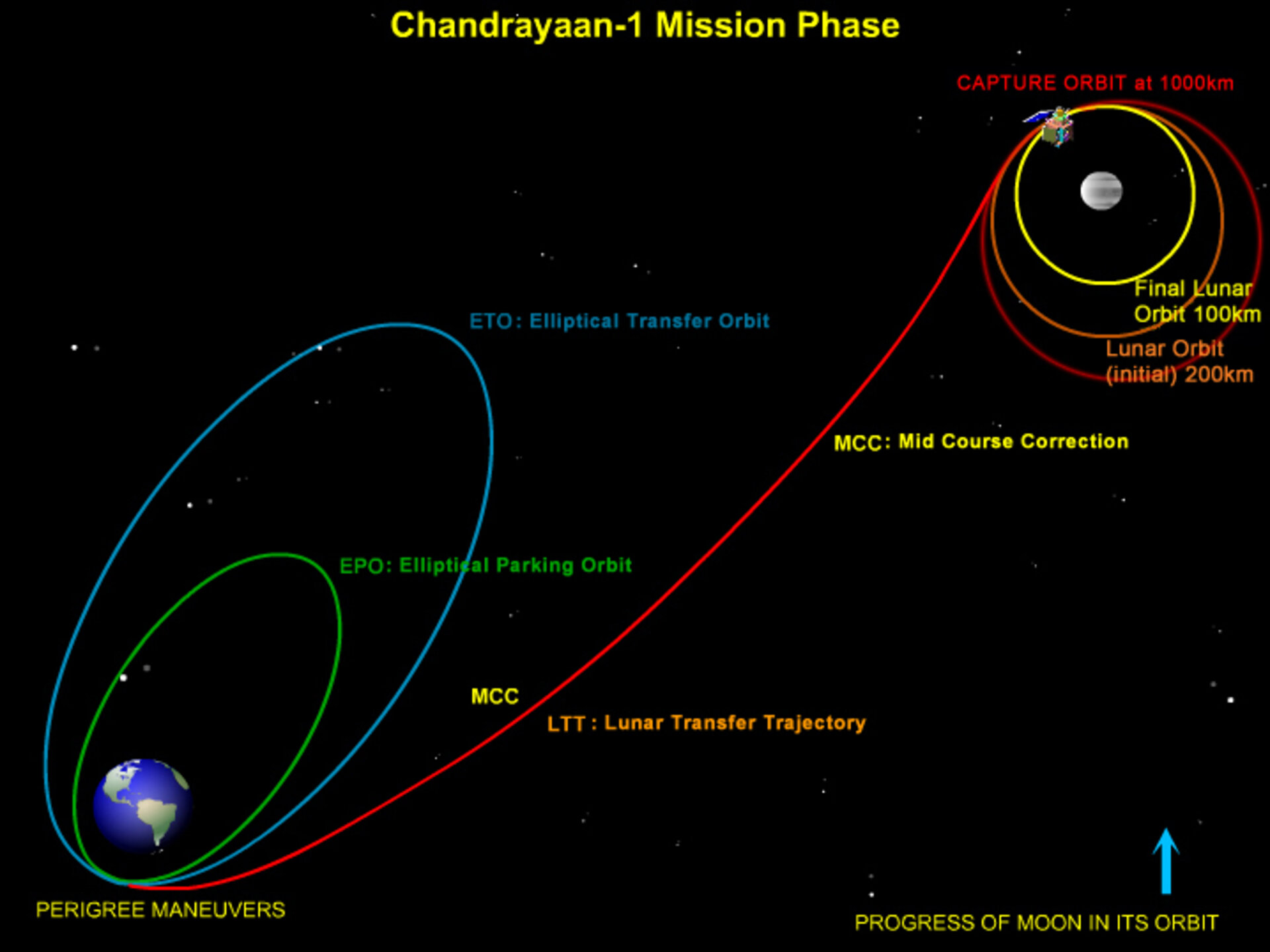
Figure: Trajectory of the Chandrayaan-1 Mission © ISRO
Aditya-L1
In September 2023, India launched a domestically developed solar research satellite into space from an ISRO launch site. This launch marked India’s first solar research mission. After reaching Lagrange Point L1 on January 1, 2024, the satellite began conducting solar observation under conditions free of solar eclipses. According to Indian space scientists, after reaching the L1 observation point, the satellite would orbit the sun at the same speed as the Earth. At this position, the satellite could harness gravity, making its expected fuel usage extremely small. The satellite carried seven types of scientific instruments to observe and study the corona (the Sun’s outermost layer), the photosphere (the Sun’s surface, which is visible to humans), and the chromosphere (a thin layer of plasma located between the photosphere and the corona). These instruments will help scientists better understand various solar phenomena that influence the Earth’s atmosphere such as sunspots and solar winds. (BBC, 2023)
Mars Orbiter Mission
In November 2013, India’s Mars Orbiter Mission (MOM; also known as Mangalyaan) launched the country’s first planetary orbiter. After traveling for around 300 days, the mission’s spacecraft successfully entered Mars’s orbit in September 2014. The cost of the mission, which was around 4.5 billion Indian rupees, was far below NASA’s budget for similar projects. During the mission, the satellite’s imaging spectrometers studied Mars’s atmosphere. In addition, the satellite’s photography equipment tried to take pictures of Mars’s two moons—Phobos and Deimos. The mission ended after 8 years in 2022, when Indian ground control lost contact with the Mars orbiter. (The Times Of India, 2013)
Indian Institute of Space Science and Technology
In September 2007, the Indian Institute of Space Science and Technology (IIST) was established in Thiruvananthapuram, Kerala, to serve as India’s premier university for training talent in space technology. This institution offers programs from the undergrad to post-doc levels in a wide range of disciplines that primarily focus on areas such as space science, space technology, and space applications. In addition to space technology and applied science, IIST also conducts academic and industry-related research. IIST has also established the Centres of Excellence, and the Ponmudi Climate Observatory. The Centres of Excellence primarily focus on areas such as advanced propulsion and lasers, nanotechnology, and virtual reality. In terms of industrial research, IIST also set up the Advanced Space Research Group (ASRG), which serves as a key administrative entity for joint space research between ISST and ISRO, and the Space Technology Innovation and Incubation Cell (STIIC).
Collaboration: Taiwan and India
Taiwan Space Industry Development Association
In October 2022, the Taiwan Space Industry Development Association (TSIDA) signed an MoU with SIA-India to facilitate future bilateral interaction through holding exchanges, seminars, international conferences and events to develop collaborative business opportunities. SIA-India Director General Anil Prakash and TSIDA Director General Jong-Shinn Wu signed the MoU via video conference. Subsequently, SIA-India President Subba Rao Pavuluri and former Taipei Economic and Cultural Center in India Representative Baushuan Ger exchanged the signed MoUs in person at the opening ceremony of the India Space Congress 2022. ISRO Chairman Sreedhara Somanath stated that in the future, ISRO will help India develop while cooperating with the world by transferring more technologies, assisting private sector companies develop the space economy, and welcoming foreign investment. (CNA, 2022)
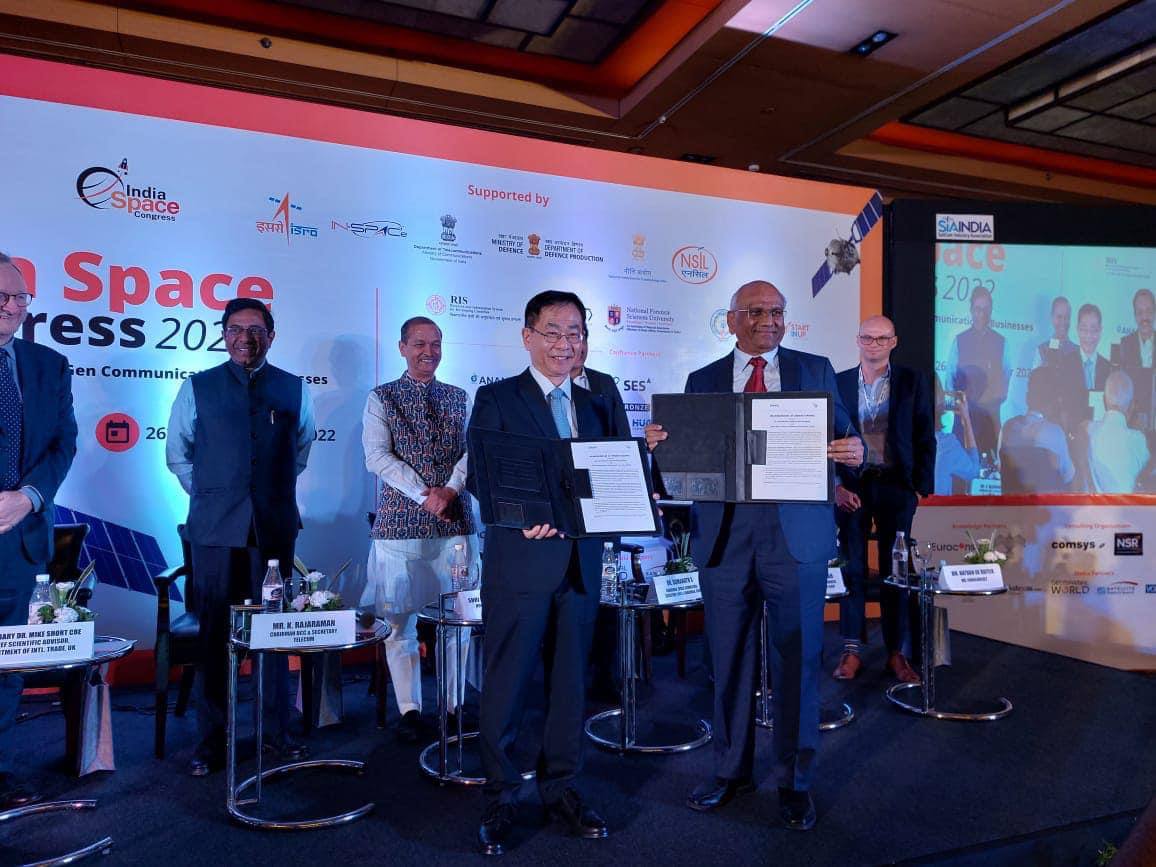
Figure: SIA-India Chairman Subba Rao Pavuluri exchanging MoUs with Taipei Economic and Cultural Center in India Representative Baushuan Ger © Taipei Economic and Cultural Center In India
National Central University INSPIRESat-1
In February 2022, INSPIRESat-1, a CubeSat jointly developed by Taiwan, the US, and India, was successfully launched from Satish Dhawan Space Centre in India. INSPIRESat-1 passed over Taiwan the day it was launched. National Central University of Taiwan (NCU), University of Colorado Boulder in the US, and India’s IIST jointly developed INSPIRESat-1 and its two scientific payloads. NCU developed one of the payloads, the Compact Ionospheric Probe (CIP), which can help better understand upper atmospheric changes and their impacts on wireless communications. NASA provided funding for the development of the second payload, a Dual-zone Aperture X-Ray Solar Spectrometer (DAXSS), which is primarily used for studying changes in the solar corona. Developing and testing of INSPIRESat- began in 2017 and took four years to complete. After being launched, INSPIRESat-1 traveled into lower Earth orbit at an altitude of 525 kilometers and then commenced its scientific observation mission. NCU Department of Space Science and Engineering Professor Chee-Wei Chang stated that this marks the launch of CNU’s second CubeSat after their first, the IDEASSat, in January 2021. Taiwan demonstrated its soft power in miniature satellites to the international community through INSPIRESat-1’s successful launch and its ability to receive transmissions. (Science Monthly, 2022)
International Collaboration
Vietnam
In 2021, India aimed to strengthen relations with Asia by beginning construction in Vietnam on a ground-based station for space observation. This initiative can be seen as supporting Indian Prime Minister Modi’s “Look East Policy” as well as an important part of India’s space diplomacy. Prime Minister Modi first proposed this policy during the India-ASEAN Conference in Myanmar in 2015. The facility, which cost 86 billion Vietnamese dong to construct, takes up four hectares of My Phuoc 3 Industrial Park in Binh Duong Province, Vietnam. In the future, the ISRO-affiliated agency, ISTRAC, will equip the facility with an antenna. (The Commune, 2021)
Singapore
In early January 2023, ISRO launched seven satellites that were manufactured in Singapore. This marked the fourth time India has helped Singapore launch satellites (the first time was one in 2011, two in 2014, and six in 2015). The mission launched via PSLV-C56/DS-SAR was the dedicated commercial mission of New Space India Limited (NSIL) for ST Engineering in Singapore. Singapore’s DSTA and ST Engineering jointly developed the mission’s primary satellite. This DS-SAR radar imaging Earth observation satellite will primarily be used to meet the satellite imaging needs of various Singaporean government agencies. The other six satellites will be used for tasks such as atmospheric observation and supporting satellite connectivity in rural areas. (DDNews, 2023)
Thailand
In April 2025, Thai Prime Minister Paetongtarn Shinawatra asked Indian Prime Minister Modi to attend the 6th Bay of Bengal Initiative for Multi-Sectoral Technical and Economic Cooperation (BIMSTEC) in Thailand. During the conference, representatives of India and Thailand discussed cooperation in science and technology, including space technology. Space technology served as one topic for a broader discussion of social issues, education, and civic interaction. In the future, India and Thailand will strengthen cooperation between technology agencies to tackle new challenges and create opportunities while expanding technology exchanges and cooperation through joint research projects and seminars. (Ministry Of External Affairs, 2025)
Japan
In April 2025 during the Third India-Japan Space Dialogue, Indian Ministry of External Affairs Disarmament and International Security Affairs Division Joint Secretary Muanpuii Saiawi and ISRO Department of Space Scientific Secretary M. Ganesh Pillai met with Japanese Ministry of Foreign Affairs Foreign Policy Bureau, Assistant Minister/Ambassador in charge of Space Policy Saita Yukio and Cabinet Office National Space Policy Secretariat Director General Kazeki Jun. These officials led delegations that included members of agencies and organizations related to space policy and operations. During the conference, representatives exchanged views on a range of space policy issues and priority areas. Discussions also included topics such as national space programs, bilaterial cooperation in space, space situational awareness, QUAD space cooperation, industry level cooperation and commercial space collaboration. (Ministry Of External Affairs, 2025) (Ministry Of Foreign Affairs, 2025)
In March 2025, India approved funding for Chandrayaan-5. This mission, which aims to explore the Moon’s south pole with unmanned equipment and a rover by 2028, was jointly proposed by India, JAXA of Japan, and Mitsubishi. India and Japan have partnered on lunar missions in the past. This includes the launch of Chandrayaan-1 in 2008, Chandrayaan-2 in 2019, and Chandrayaan-3 in 2023. Chandrayaan-2 lost connection with the lunar probe during landing, but Chandrayaan-3 completed its mission in August 2024. Chandrayaan-4 is scheduled to launch in 2027. (The Hindu, 2025) (India Today, 2025) (India Today, 2023) (ISRO, 2019) (The European Space Agency, 2008)
United States
India has closely partnered with the US on space-related initiatives. In September 2014, ISRO and NASA signed an agreement to cooperate on launching satellites and conduct the NASA-ISRO SRA Mission (NISAR). For this mission, NASA will provide an L-band synthetic aperture radar, a high-rate communication subsystem for scientific data, GPS receivers, a solid-state recorder, and payload data subsystems. ISRO will provide the spacecraft bus, S-band radar, the launch vehicle, and associated launch services.
NISAR launched a Synthetic Aperture Radar satellite in late July 2025. This satellite’s radar can scan an area with a width of 240 kilometers. This satellite will observe the Earth on a 12-day cycle and provide data, such as glacial retreat in the Himalayas and identifying potential landslide zones in South America, to scientists and disaster response agencies. This Synthetic Aperture Radar plans to be in operation for five years and will enhance the transparency and accessibility of climate research and disaster response by providing information free of charge to users around the globe. (NISAR, 2025) (CNA, 2025) (CNA, 2025)
During a meeting in September 2023, former President Biden and Prime Minister Modi jointly pledged that both countries would further strengthen cooperation in space. The two leaders also completed a strategic framework for cooperation on human spaceflight and discussed the relevant capacity building and training for a joint effort to the International Space Station. A statement also noted that both Biden and Modi welcomed efforts toward the establishment of a “working group for commercial space collaboration”. That potential collaboration would slot into an existing structure, the India-U.S. Civil Space Joint Working Group. India and the US also intend to increase coordination on planetary defence to protect planet Earth and space assets from the impact of asteroids and near-Earth objects, including U.S. support for India's participation in asteroid detection and tracking via the Minor Planet Center. (Space.com, 2023)
India's Policy on Space Technology
| Agency | Policy, Strategy, Project & Initiative |
|---|---|
|
Department of Space (DoS) Indian Space Research Organisation (ISRO) Indian National Space Promotion and Authorization Center (IN-SPACe) NewSpace India Limited (NSIL) |
Indian Space Policy 2023 |
| Indian Space Research Organisation (ISRO) |
Mars Orbiter Mission (MOM / Mangalyaan) |
|
Indian Space Research Organisation (ISRO) Japan Aerospace Exploration Agency (JAXA) |
Lunar Polar Exploration Mission (LUPEX) |
| National Central University, Taiwan University of Colorado Boulder, United States Indian Institute of Space Science and Technology (IIST), India |
INSPIRESat-1 |
| NewSpace India Limited (NSIL) | DS-SAR Mission |
|
Indian Space Research Organisation (ISRO) National Aeronautics and Space Administration (NASA) |
Reference/Sources:
India's Sources
- Ministry of External Affairs (2025.04) Joint Declaration on the Establishment of India-Thailand Strategic Partnership (April 03, 2025)
- Ministry of External Affairs (2025.04) Third India-Japan Space Dialogue ( April 01, 2025)
- India Today (2025.03) Isro's Chandrayaan missions reveal hidden wonders of the cold lunar world
- India Today (2025.03) Chandrayaan-3 reveals there could be more water on the Moon than we thought
- The Hindu (2025.02) Chandrayaan-4 to launch in 2027: Jitendra Singh
- India Today (2023.05) Chandrayaan-3 launch date: Isro to lift-off India's ambitious moon mission on
- DDNews (2023.01) India-Singapore Space Partnership Achieves New Milestone With Satellite Launch By ISRO
- The Times of India (2022.12) Isro launched 177 foreign satellites for 19 countries
- The Commune (2021.07) ISRO to build ground station in Vietnam under Look East policy to help ASEAN countries
- ID (2021.07) Space diplomacy: India building ground station for Asean countries in Vietnam
- ISRO (2019.07) GSLV MkIII-M1 Successfully Launches Chandrayaan-2 spacecraft
- Deccan Chronicle (2015.05) After Mars, ISRO plans Venus odyssey
- The Times of India (2013.10) India to launch Mars Orbiter Mission on November 5
- The Times of India (2008.11) Mission Accomplished: India fifth in world to reach moon
Foreign Sources
- NISAR (2025) NASA-ISRO SAR Mission
- Ministry of Foreign Affairs of Japan (2025.04) The Third Meeting of the Japan-India Space Dialogue
- New Zealand Foreign Affairs and Trade (2024.11) Public consultations: Green Economy Joint Working Group with Chile and Singapore
- BBC (2023.09) Aditya-L1: India successfully launches its first mission of the Sun
- The Economic Times (2009.09) Chandrayaan-1 off radar, but will work for 1000 days
- The European Space Agency (2008.10) Chandrayaan-1 now in lunar orbit
- JAXA (2007.12) Towards a New Era of Space Development: International Cooperation Between India and Japan
- Space.com (2023.09) India, NASA to cooperate on human spaceflight and planetary defense
- The New York Times (2019.11) India Loses Contact With Chandrayaan-2 Moon Lander During Its Descent
Domestic Sources
- 中央社 (2025.07) 印度與NASA合作 首度發射雷達成像衛星監控天災
- 中央社 (2025.07) 美印攜手研發地球觀測衛星將升空 協助預測災害
- 中央社 (2022.10) 台印度太空產業簽署備忘錄 建立合作平台
- 駐印度台北經濟文化中心 (2022.10) 台印簽署太空產業合作MOU
- 科學月刊 (2022.03) 臺美印跨國合作人造衛星 將進行太空天氣觀測

